
The tweet from General Electric reads: “This is a 3D printed jet engine.”
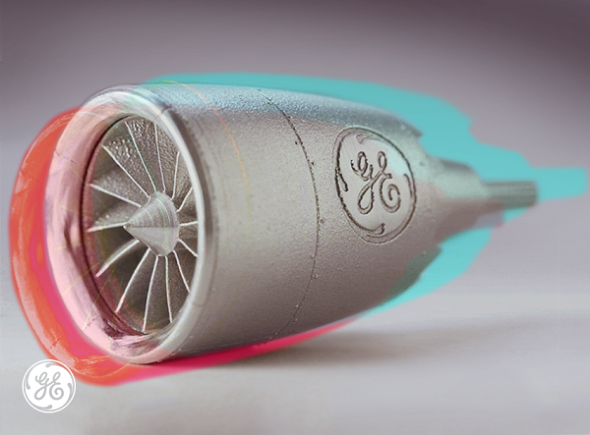
Is it real? Well, yes and no.
“While it’s not to scale, this 1.5 inch long model was made entirely from direct metal laser melting and required no assembly,” explains GE in another tweet.
Does it work?
“Not quite,” GE acknowledges. “However, the fan blades are able to rotate!”
So it’s a tiny 3D printed model of a jet engine. That’s cool.
But surely this doesn’t mean we’ll be making real airplane parts for real airplanes using this same technology?
Actually, it means exactly that, as a recent story in the Hartford Courant explains.
Even NASA is getting in on the 3D printing act.
I assume these GE and NASA folks know what they’re doing lest they wouldn’t be working at GE and NASA.
However, when I was a kid my dad was a manufacturing engineer for Texas Instruments and he oversaw a line that made circuit breakers. Any time there was an airliner crash – and they were much more frequent back then – he’d mutter something like “I hope my circuit breakers weren’t on that thing.”
Someday one of these 3D printed parts will elicit similar mutterings.
(Update: Here’s more on what NASA’s doing with 3D printing: They’re cutting production times and saving money.)
Welcome regulars and passersby. Here are a few more recent buzzblog items.
- Minecraft in Latin? … Perhaps now the pope will play.
- State finds grocery store pricing 100% accurate?
- Creator of hashtag explains why he didn’t patent it.
- Hey, Cambridge, Netscape 4.0 was released in 1997.
- Hidden yodelers on Yahoo homepage fall silent.
- Torvalds: Stop me before I curse again.
- Nothing says narcissist like wearing Google Glass on a date.
- Microsoft’s opening act since Windows 95: Weezer.
- Will entering your ATM PIN in reverse summon the police?
- 2013’s 25 Geekiest 25th Anniversaries