Supercomputers aim for exascale performance with really low power requirements
Supercomputers have a big problem: The amount of power they consume. Consider the Chinese Tianhe-2 (MilkyWay-2) at the National Super Computer Center in Guangzhou, currently the world’s top performing machine; its 3,120,000 cores produce 33,862.7 teraflops; that’s an efficiency of 1.9 gigaflops per watt.
China’s Tianhe-2 (MilkyWay-2) supercomputer
While that power efficiency might sound good, the world’s greenest supercomputer is, according to The Green500 List, the:
TSUBAME-KFC, a heterogeneous supercomputing system developed at the Tokyo Institute of Technology (TITech) in Japan, tops the list with an efficiency of 4.5 gigaflops/watt.
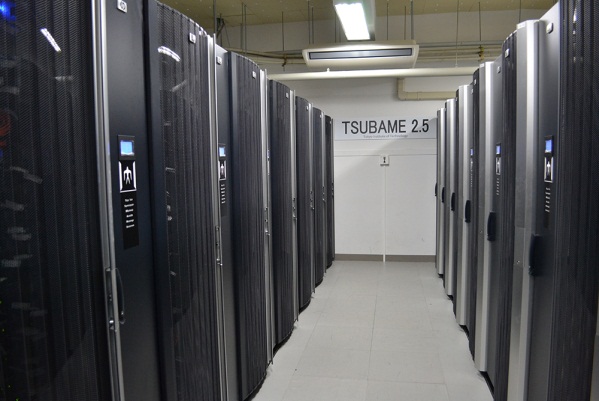
Japan’s TSUBAME-KFC, the current “greenest” supercomputer
Power efficiency is actually critically important in supercomputers because the bigger and faster they get, the harder it is to power and cool them. Indeed, the US Defense Advanced Research Projects Agency (DARPA) announced in 2010 the Ubiquitous High Performance Computing (UHPC) program with the goal of building an exascale supercomputer by 2018 that will require only a total of 20 megawatts — that works out to 50 gigaflops per watt.
A new machine, the Wilkes which went operational in October this year, ranks #2 on The Green500 List with a rating of 3.6 gigaflops/watt. Housed at Cambridge University in England, the Wilkes (named after the Cambridge University pioneer Maurice Wilkes, who built EDSAC, one of the first programmable computers, in 1949) was specifically designed for power efficiency.
Cambridge University’s Wilkes supercomputer
The Wilkes employs 128 Dell T620 servers and 256 NVIDIA K20 GPUs interconnected by 256 Mellanox Connect IB cards to achieve 240 teraflops. This performance gives the Wilkes position 166 in the Top500 November 2013 list.
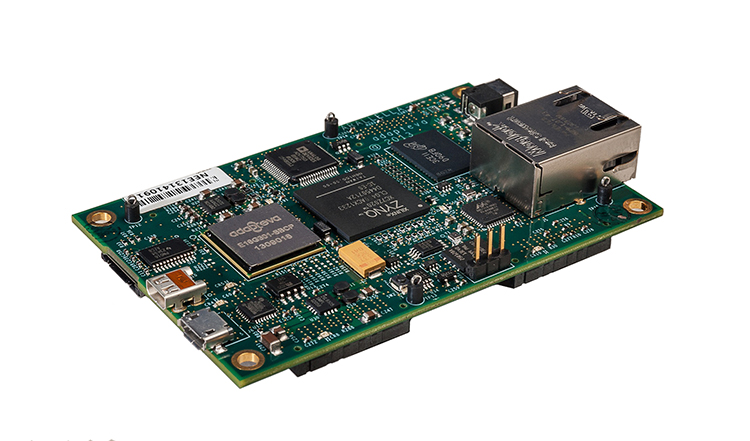
The Adapteva Parallella-16 board
Interestingly, Adapteva‘s Parallella project which was successfully funded via Kickstarter just over a year ago (I wrote about the project and am a backer) is about to ship boards based on theri Ephiany chip that deliver an amazing 35 gigaflops per watt! This is the closest anyone has come to meeting DARPA’s UHPC goal though, quite obviously, all of the infrastructure to achieve a exaflop machine would decrease the efficiency of system built from Adapteva chips considerably. Adapteva’s next chip generations have been mapped out:
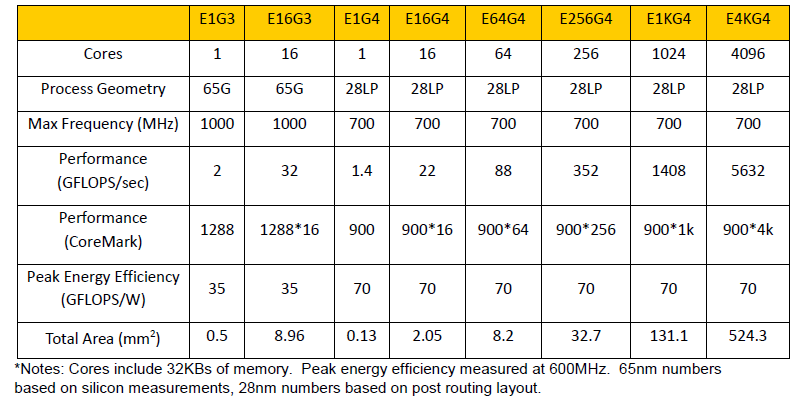
Adapteva’s Epiphany parallel processing chip product lines
But Adapteva has even bigger plans; by 2018 the company expects to produce a 64,000 core chip that will deliver 100 teraflops while using just 100 watts (that’s a teraflop per watt!). Link ten of those chips together and voila! You have an exascale machine. If you assume that the resulting system’s power efficiency is halved that’s a promise of an exaflop for something around two kilowatts!
Why does all of this matter? Because exascale computing will have the most incredible payoffs including making large scale (whole body) biological simulation practical, realize the goals of the Human Brain Project, and enable many fields of research to advance overnight … and 2018 is just around the corner.
Power up your comments below or to gearhead@gibbs.com then follow me on Twitter, App.net, and Facebook.