Florida State, University of Pittsburgh researchers look to give smartphones more life
While smartphone headlines are dominated by the latest and greatest devices, from Sprint’s new 3G/4G phone – the HTC EVO 4G – to Apple’s anticipated new iPhone, a pair of university researchers have quietly been awarded a $1.2 million National Science Foundation grant to address the most vexing thing about mobile phones: short battery life.
With smartphones being used for so much more than voice calls and emails these days, the four-year research project by a pair of Florida State University computer science professors and a cohort at the University of Pittsburgh is ever more pressing.
They’ll be working to design a more energy-efficient processor for mobile embedded systems, an advance that could actually lower mobile device costs by simplifying the handhelds.
“The problem is that current techniques used in [more traditional] pipeline designs can waste power by performing redundant and sometimes unnecessary computations,” said David Whalley, who is chair of the Department of Computer Science at Florida State, in a statement. He and Florida State colleague Gary Tyson already have a patent accepted and another under review related to low-power design.
This isn’t the first time Whalley and Tyson have caught the NSF’s eye. It is funding a separate $500,000 project in which they are trying to come up with a way to secure mobile computing environments by limiting malware outbreaks to as few systems as possible.
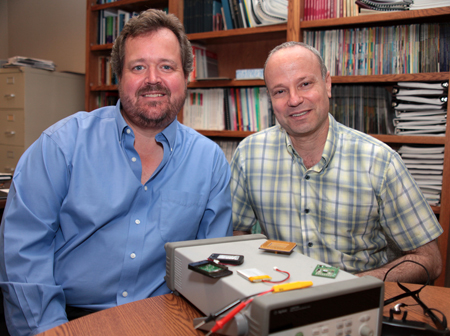
Gary Tyson, left, and David Whalley (photo: Michele Edmunds/FSU Photo Lab)