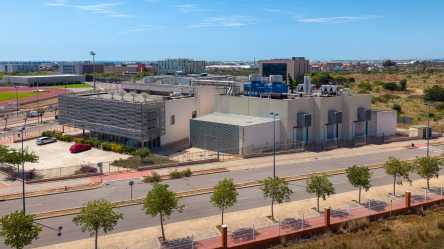
Minnesota company uses outside air and giant generators to keep new data center cool and costs down
When temperatures dip below zero, homes and businesses in Eagan, Minn., crank up their heat, creating a peak load on the local power company, Dakota Electric.
EAGAN, MINN. — When temperatures dip below zero, homes and businesses, crank up their heat in Eagan, Minn., creating a peak load on the local power company, Dakota Electric.
The new green: Data centers go au naturale
That’s when Thomson Reuters Legal, a division of Thomson Reuters, takes its three local data centers, including a brand-new 17,000-square-foot raised-floor facility, totally off the utility grid.
The global business information provider kicks up its diesel-fueled generators — four two-megawatt behemoths at each data center — and operates off of those. This returns 24 megawatts to the grid — enough to heat 6,500 homes, the company says. And, it saves Thomson Reuters about 40% on its total bill.
The load-shedding agreement stems from a close working relationship between Thomson Reuters and Dakota Electric.
“We do a lot of a long-range planning with the utility company. It knows [our long-term plans], and can meet our needs. And we, of course, want to keep costs down so anything we can do to keep the utility from having to build more power-generation capability is good,” says Rick King, global head of technology and operations at Thomson Reuters, Legal.
“So for the cost of running our generators, which we need to do occasionally anyways to make sure they’re functional, we can go offline a certain number of times a year — usually not more than once or twice a month when demands are high in the summer and winter — and keep our rates down,” he adds.
A chilly hot spot
Aggressive utility pricing was one of two reasons Thomson Reuters, Legal added a third data center to its existing headquarters complex rather than locating it elsewhere. The second was location, for three reasons.
For one, building on its own land would be less expensive than doing so elsewhere. Thomson Reuters owns 271 acres in Eagan, which is about 10 miles south of St. Paul. Plus, geography wasn’t an issue since the company already had redundancy accounted for with data centers in Michigan and Ireland, King says.
Two, the northern tier of the country generally is protected from natural calamities. “We’re out of the earthquake and tornado belts,” King says.
And three, Minnesota has no shortage of cold air usable for circulating through and cooling off a data center. Thomson Reuters reports using ambient-air cooling between 3,300 to 3,500 hours, or roughly 140 days per year.
Cooling was a huge concern for the data center team. With a state-of-the-art IT infrastructure, the new data center’s footprint requires 150 watts per square foot of power. This compares with 60W per square foot required by the other two data centers in Eagan, themselves updated within the last four years from 30W per square foot.
All of the data centers take advantage of the air flow for cooling, but the new one does so more effectively than the older two, King says. That’s because the new data center features overhead cabling and fan assemblies built on top of data center racks to maximize airflow. The old data centers run cabling under the raised floors, which impedes airflow.
Water works
With an eye toward the future, Thomson Reuters also has plumbed pipes into the foundation should water cooling the data center come back into vogue, as some forecast it might.
Ages ago, chilled water was the cooling mechanism of choice for mainframes. But once those were gone, the idea of water on the data center floor was evil, King explains.
“Now, because of the price and complexity of cooling today, people have begun talking about water cooling again. So we’ve allowed for that in our design. If water ever becomes something that needed to be introduced again from a technology point of view, our physical plant could accommodate it,” he says.
Business growth
In the Eagan data centers, which total 100,000 square feet of raised floor area, Thomson Reuters supports the massive information databases required by its global legal business, as well as portions of its tax and accounting, scientific, healthcare and miscellaneous other businesses.
For example, the company serves about 30,000 users concurrently searching for information across its 32,000 Westlaw legal databases. Westlaw handles some 1.1 million searches daily, King says. The underlying systems supporting those searches generate about 125 million requests a day and pull out 3.5 million documents per hour, he adds.
Content grows constantly. “We’re continually adding more content to Westlaw — historical content, new content, new court decisions, for example,” King says. “And that often means adding more servers and storage.”
Today, the three Eagan data centers house slightly more than 13,000 physical servers, 7,500 virtual servers and about 8 petabytes of data between its network-attached storage systems and storage-area networks, King says. Plus, it still has about 23,000 mainframe MIPS, he adds.
The company’s power needs obviously are growing rapidly, but virtualization has helped tamp them down a bit. The data center team, a collaborative group of IT and facilities personnel, estimates it has saved 1 mW with the 7,500 virtual servers, King says.
The new data center already operates at about 60% capacity, and with rapid growth of the company’s electronic stockpiles, King says a fourth will be needed soon.
Schultz is an IT writer in Chicago. She can be reached at bschultz5824@gmail.com.