The new Brave browser is impressively fast for its early state. How does it stack up with Chrome, Firefox, and Internet Explorer 11 in speed and benchmark tests?

Brave, the new company from Mozilla Corp. co-founder Brendan Eich (who served a brief, controversial term as CEO), has released the first beta of its eponymous web browser. Even in its early state, it’s a scorcher, competitive with and in some cases outperforming mature browsers in some benchmarks.
Brave works by blocking outside online ads and ad tracking to speed up performance, rather than requiring an add-on ad blocker or other privacy protectors. The beta, released last week, is available on Windows and OS X on the desktop, with iOS and Android versions to come.
Eich has outlined his philosophy, which I won’t rehash since Gregg Keizer did a fine job in his article covering the announcement. I would only add that I like the notion of blocking outside ads because that’s where malware is coming from, as Forbes recently learned the hard way. Brave scrubs websites of most of their ads and all tracking, and replaces those ads with its own. Hopefully Brave will do a better job monitoring its ads for malware than some of the ad delivery networks have done.
Rather than reinvent the wheel, Eich and his new company built the browser on Chromium, the open source browser from Google on which Chrome is built. This raised a few eyebrows and was seen as a middle finger at Mozilla over its treatment of Eich, but he denies it.
In its current state, Brave 0.7 is mighty primitive. I can’t even load a bookmark file, and most basic menu items are missing. The UI is missing some basic pieces, and looks even more primitive and simplistic than Windows 10. And I’ve found at least one repeatable bug. Go to YouTube, start any video, and then hit the reload key (F5). The video won’t reload. You’ll be staring at a black space where the video should be.
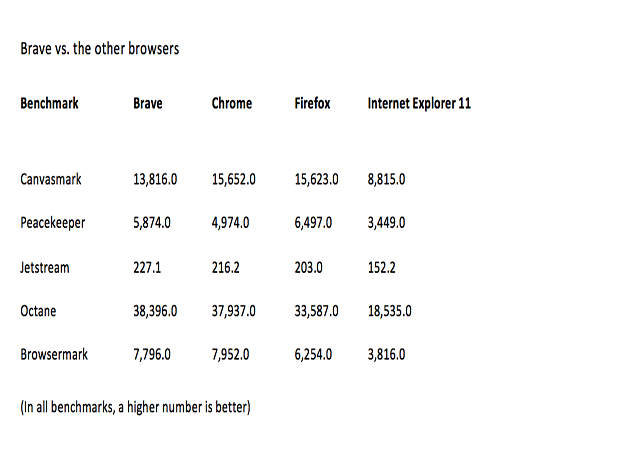
So, on to the benchmarks. Most of these are JavaScript benchmarks, but some are all-encompassing of the browser performance, like Peacekeeper. The test system is a Core i7-4770k system with 16GB of memory, running Windows 7 on an OCZ Vertex 4 SSD with an Asus STRIX GTX 970 graphics card.
 Andy Patrizio
As you can see, it beats both Firefox and Chrome in three tests, while losing in two. Mind you, this is beta code. It’s far from optimized and probably has a lot of debugging code in it. So it has much room for improvement.
That said, the browser works well. You have to manually enter URLs, or paste them in, since there is no bookmark file. Like Chrome, the URL box doubles as a search box, and suggestions start to show as you type.
And this is really where you see the difference. Pages load instantly. I can’t really benchmark page loads since they happen faster than I can start/stop the stopwatch. Pages with a lot of ads and other junk, ranging from Amazon to Fark to NewEgg to eBay, you name it, load up instantly with Brave, while Firefox, my browser of choice for a variety of reasons, often had lags in load time, and sometimes loaded pages in pieces. Plus, I could safely browse Forbes without being nagged to turn my ad blocker off, although Newsfactor still pestered me to turn my ad blocker off.
Brave is off to a good start, and with a recent report stating 80% of Internet users would consider using an ad blocker, there’s clearly a market for it. The challenge will be getting people to switch, which has proven daunting for Microsoft Edge. The Chromium base means extensions and plugins will work, so that might make the lure easier.