
This year's most-read stories about Intel span leadership changes, CPU launches, new major shareholders, and plenty of industry scrutiny.
It’s been a roller coaster of a year for Intel, marked by the arrival of a new chief, new Xeon processors, select product divestitures, and sizable layoffs.
Under the leadership of CEO Lip-Bu Tan, who took the helm in March, Intel delivered the first Xeon built on its next-generation 18A process node, navigated the divestiture of its FPGA business, and upped its efforts to restructure the company and regain market leadership amid strengthening competition. It also inked a $5 billion partnership with Nvidia and saw the U.S. government take a 10% stake in the company.
Here are our top stories about Intel in 2025, organized in five sections:
- CEO Tan’s arrival and early moves
- Vendor partnerships and equity investors
- Product divestitures and talent loss
- Significant Xeon news
- Industry analysis of Intel’s product roadmap and market outlook
Lip-Bu Tan’s leadership
Intel CEO: We are not in the top 10 semiconductor companies
In July, Intel’s CEO Lip-Bu Tan told employees that Intel is not among the leading chip companies, a stark contrast to the perpetual sunny, cheerful optimism of his predecessor Pat Gelsinger.
Intel under Tan: What enterprise IT buyers need to know
Intel’s appointment in March of semiconductor veteran Lip-Bu Tan as CEO marked a critical moment for the company and its enterprise customers. With rising competition from AMD, Arm-based chips, and RISC-V alternatives, Intel faces mounting pressure to defend its x86 dominance.
New Intel CEO Lip-Bu Tan begins to lay out technology roadmap
After being on the job for two weeks, Intel CEO Lip-Bu Tan gave a major speech at a partner conference where he said the ailing company needs to get its act together, and he doesn’t want customers to hold back on their criticism of Intel.
Intel taps semiconductor veteran Lip-Bu Tan as new CEO
In March, Intel announced its new CEO is Lip-Bu Tan, a semiconductor industry veteran. Tan previously was CEO of Cadence Design Systems, which makes software products used to design and verify complex electronic systems. Cadence’s toolset is used by Intel and all of the other major chip designers.
Customer wins and investments
IBM Cloud speeds AI workloads with Intel Gaudi 3 accelerators
IBM announced in April that it would make Intel Gaudi 3 AI accelerators available on IBM Cloud to help customers scale gen AI workloads and optimize performance for AI inferencing and fine-tuning.
Intel will design CPUs with Nvidia NVLink in return for $5 billion investment
Intel is collaborating with Nvidia to design CPUs with Nvidia’s NVLink high-speed chip interconnect, it said in September — just months after committing to co-develop a competing interconnect, UALink, with AMD, Broadcom, and other tech companies. Nvidia will invest $5 billion in Intel stock as part of the agreement.
Intel saga continues: Federal bailout considered
Rumors emerged in August of the federal government’s plans to purchase a 10% stake in Intel in a bid to speed up completion of its advanced fabrication facilities. The deal came together after a meeting between President Donald Trump and CEO Lip-Bu Tan, which took place after President Trump called for the resignation of Tan.
Who wins/loses with the Intel-Nvidia union?
Nvidia dipped into its $56 billion bank account to acquire a 5% stake in Intel for $5 billion, making it the second largest shareholder of Intel stock after the federal government’s recent investment. The deal, announced in September, provides Nvidia greater access to the x86 ecosystem, important for the enterprise data center market, and provides Intel with access to GPUs that have demand and can move their CPU products as well.
Market exits, lost talent
Intel sells off majority stake in its FPGA business
Intel spun off its programmable solutions group as a standalone FPGA company, selling a majority stake in the company to a private equity firm in April. Intel is taking a fairly hefty loss on this deal. It acquired Altera in 2015 for $16.7 billion, but the deal with Silver Lake technology investments values Altera at $8.75 billion total and Intel is getting $4.4 billion for the sale.
Intel eyes exit from NEX unit as focus shifts to core chip business
Intel in May said it might sell its Network and Edge (NEX) business, marking the latest step in a broader effort to reshape the company under new CEO Lip-Bu Tan.
Qualcomm hires Intel’s Xeon designer for data center
The chief architect for Intel’s Xeon server processors defected to chip rival Qualcomm. Sailesh Kottapalli, a 28-year Intel veteran and chief architect for the company’s Xeon processors, announced in January that he joined Qualcomm as a senior vice president.
Intel decides to keep networking business after all
Intel CEO Lip-Bu Tan has been on a mission to divest the company of all non-core technologies, and its Network and Edge Group, commonly referred to as NEX, was the largest group scheduled for divestiture. But after a few months of shopping it around, either Intel couldn’t get the deal it wanted or changed its mind. In December, Intel said it has cancelled plans to divest itself of NEX.
Significant tech advances
Intel touts efficiency and performance in new 288-core Xeon processor
The Hot Chips conference in August was the backdrop for Intel’s newest Xeon processor, codenamed Clearwater Forest. It’s the first Xeon built on the company’s next-generation 18A process node.
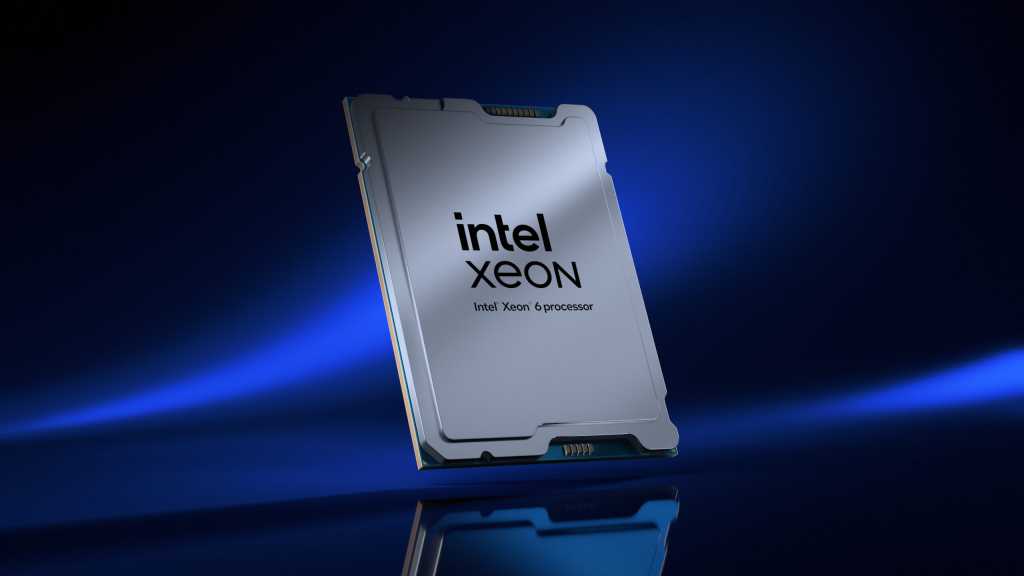
Intel targets edge, high-performance computing with extended Xeon 6 chip line
Intel expanded its Xeon 6 line of processors, adding models 6700/6500 for high-performance cores and edge computing devices to the family. Announced in February, the new Xeon 6 processors feature P-cores (performance-cores) for high-performance computing.
Intel details new efficient Xeon processor line
In October, Intel revealed more details of its next-generation Xeon 6+ E-core CPU family, codenamed “Clearwater Forest,” with a focus on power and performance efficiency. Intel has split its Xeon product line into two categories: the P line of high-performance cores and the E line for efficiency for tasks and processes that are less performance sensitive.
New Intel Xeon 6 CPUs unveiled; one powers rival Nvidia’s DGX B300
Intel in May unveiled three additions to its Intel Xeon 6 series of CPUs that are designed to manage GPU-powered systems. One, the Xeon 6776P, is currently serving as the host CPU for Nvidia’s DGX B300, its latest generation of AI-accelerated systems. One industry analyst views the launch as confirmation that the chip maker is “looking to regroup and pick fights it thinks it can win.”
Industry analysis
Despite the hubbub, Intel is holding onto server market share
Intel is holding on to market share in both client and server markets against AMD despite the seemingly endless stream of bad news surrounding the company. Second-quarter 2025 chip sales were roughly flat for both companies with very little share trading hands, according to August data from Mercury Research.
Can Intel cut its way to profit with factory layoffs?
Intel plans to lay off up to 20% of its manufacturing sector employees starting in July, according to a media report published in June. The rumored cuts suggest the company is running out of options as it seeks a return to profitability and navigates faltering demand for its core products.
What Intel needs to do to get its mojo back
The once undisputed king of the chip market, Intel is on its knees. At the beginning of 2025, we looked at what it needs to do to get back on its feet.
Intel sees supply shortage, will prioritize data center technology
In October, Intel reported better than expected third-quarter financial figures, reflecting a turnaround in sales, reduced operational expenses, and a renewed focus on its core business. On the downside, Intel is enjoying a little too much success and is seeing a shortage of supply.