Copper and fiber optics coexist in today's AI data centers, with copper typically used for short connections and fiber for long-distance, high‑capacity links.

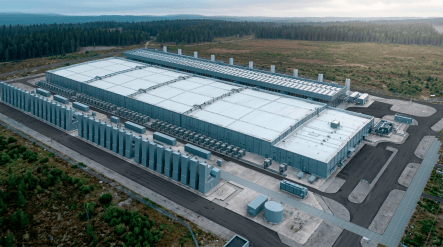
Data movement over the network is more important than ever, thanks to artificial intelligence and, in particular, dedicated AI data centers. Large language model (LLM) training and AI inference require terabytes of data stored in data centers the size of football stadiums. In addition, efforts to cluster multiple sites are increasing, which means that data-center networking distances are increasing.
There are two forms of network cabling: copper and fiber optics. The two technologies are very different, but they coexist in data centers. Businesses need both to operate data centers at maximum efficiency. At the recent Nvidia GTC conference, network connectivity and the use of copper and fiber together were key topics of discussion.
Copper cables transmit data using electrical signals, while fiber uses light. Copper remains the dominant option for short connections because it is inexpensive, extremely reliable, and consumes virtually no power. Fiber, meanwhile, is indispensable for long‑distance, high‑capacity links—but at a significant energy cost, says Gilad Shainer, senior vice president of networking at Nvidia.
“Copper doesn’t consume much power, it’s nearly zero, and it’s very reliable. It’s hard to break copper cables,” he said. “So you want to use copper, especially when the limiting factor on how much compute you can bring into their factory depends on the power that you have available to you.”
In a side-by-side comparison using 1.6 Tb/s ports, optical cables can consume up to 30 watts of power versus virtually none for copper. That gap has major implications at scale. In massive AI installations with thousands of connections, optical power draw can quickly add up to a meaningful share of a facility’s total energy usage.
Despite its efficiency, copper has a hard physical limitation: distance. As data rates increase, the maximum length of passive copper cables shrinks dramatically.
At common speeds—such as 1Gb/s—copper Ethernet cables can span long distances without issue. But at the speeds used inside AI systems, the story changes. At roughly 200 Gb/s per lane, passive copper connections are limited to only a few meters, typically around two to three meters. Beyond that, signal integrity breaks down and fiber becomes inevitable, said Shainer.
This constraint shapes how modern data centers are built. Copper is ideal for scale‑up networking, such as connecting GPUs within the same rack, where distances are short. Scale‑out networking—linking racks across rows, halls, or entire buildings—requires fiber optics.
Fiber also matches copper in raw speed potential. Both media can support extremely high data rates, but fiber maintains those speeds over vastly longer distances. The tradeoff is higher cost, greater fragility, and significantly higher power consumption. Copper cables are physically tough and difficult to damage. Fiber cables contain delicate glass strands that can break if bent or mishandled.
To reduce the energy penalty of fiber, chip and networking designers are rethinking how optical components are integrated. A newer approach being taken by companies like Point2 and others is co‑packaged optics, which places the optical engine directly next to the switch ASIC.
CPO dramatically shortens the electrical path, reducing power consumption. In this configuration, the same 1.6 Tb/s port can consume about five watts instead of 20, according to Shainer.
So fiber and copper are not an either/or solution; they must coexist, with copper covering short distances and fiber covering long distance. “I don’t see that there’s one versus the other. I see them as two elements that you use when you design or build an AI factory. I cannot imagine someone that will say, ‘I can use copper, but I choose not to,’ because it doesn’t really make sense,” he said.