IT spending will cross the $7 trillion mark for the first time in 2027 as AI investments accelerate, Gartner predicts.

AI infrastructure and AI software will shape the next $1 trillion dollars in IT spending growth, according to Gartner. The research firm is anticipating a significant rise in AI-driven spending in a wildly changing tech environment.
“Spending on AI-optimized servers, AI-optimized infrastructure as a service (IaaS) and AI software platforms continues to strengthen as organizations seek to industrialize AI deployment. At the same time, hardware markets are experiencing growing pressure from memory-related inflation,” the research firm stated.
Gartner’s latest forecast calls for worldwide IT spending to reach $7.35 trillion in 2027, up 15% from 2026.
“Collectively, the market forces are reinforcing spend around AI infrastructure, AI-enabled cloud platforms and advanced software ecosystems, as these are the most attractive opportunities in global IT spending,” said John-David Lovelock, distinguished VP analyst at Gartner, in a statement. “Increasingly, the growth of the digital economy is being determined not only by software adoption, but also by the ability to finance, build and monetize AI infrastructure at an unprecedented scale.”
Lovelock spoke about the AI boom and future tech spending and adoption trends at the Gartner IT Symposium/Xpo 2026, going on this week in Orlando, Florida. The analyst group also shared its annual tech predictions list (first published last month at Gartner’s Australia event and not to be confused with Gartner’s top 10 tech trends list).
At the Orlando event, Daryl Plummer, distinguished vice president analyst and Gartner Fellow, recapped the firm’s top predictions for 2027 and beyond:
By 2029, 80% of new applications will be intentionally disposable—used for less than one year.
“AI is making application development so accessible that employees will increasingly create temporary applications to meet short-term business needs. Organizations face new governance, security, compliance and records management challenges, particularly when they influence decisions or access sensitive data,” Gartner stated.
By 2030, $10 trillion in enterprise-owned energy will make Global 2000 firms unexpected power providers—selling to grids and AI data centers, reshaping the utility industry.
“Surging electricity demand from AI and data centers is driving enterprises to invest heavily in energy generation, storage and management assets, blurring the traditional line between energy consumers and power providers. As energy becomes a strategic, software-defined asset, organizations will need new capabilities to optimize production, storage and consumption,” Gartner stated.
By 2030, insurers—not regulators—will drive AI governance
“Organizations are shifting from policy-based AI governance to operational governance that embeds controls directly into AI systems and workflows. As AI risks and liability concerns grow, insurers are expected to influence governance practices by encouraging stronger oversight, risk management and technical controls,” Gartner stated.
By 2030, 80% of organizations with public-facing AI will have experienced a “cost exhaustion attack” creating excessive AI cost.
“The rise of public-facing AI is creating a new cybersecurity risk called cost exhaustion attacks, where malicious actors deliberately drive excessive AI usage to increase operational costs. As AI becomes more embedded in customer-facing applications, organizations will need to treat token consumption and AI usage patterns as both cost management and security concerns,” Gartner stated
By 2030, 80% of front-line workers employed by international companies will be assisted by physical AI systems.
“Physical AI is extending AI into the physical world through technologies such as robots, drones, autonomous vehicles and other embodied systems that sense, interact with and influence their surroundings. Many industries are already using physical AI to improve safety, automate repetitive and hazardous work, and gain operational insights,” Gartner stated.
By 2030, 80% of Global 500 companies will contractually make their CIO the “evidence custodian” for AI accountability.
“As AI becomes embedded in critical business processes and decisions, organizations face increasing pressure to ensure accountability, transparency and oversight of AI actions. This is expanding the role of technology leaders in overseeing AI accountability and ensuring governance guardrails are applied consistently across the organization,” Gartner stated.
By 2029, 60% of organizations deploying AI will establish a dedicated function responsible for mapping AI total cost to value or profit.
“As organizations deploy more agentic AI, managing token consumption is becoming a business priority as costs rapidly escalate, making it increasingly difficult to link spending to business value. Organizations need greater visibility into AI consumption patterns and stronger governance to balance cost efficiency with value creation,” Gartner stated.
By 2028, 60% of Global 500 companies will embed AI FinOps control at inference.
“AI spending is becoming harder to predict and control as organizations scale AI tools and agentic workflows, driving a shift from retrospective cost reporting to real-time AI FinOps governance. As AI becomes a larger operational expense, organizations will increasingly focus on measuring cost per task and token efficiency to maintain margins and maximize value,” Gartner stated.
By 2029, 25% of Global 500 companies will continuously innovate componentized AI-powered offerings, creating a competitive moat.
“As AI-native competitors introduce more customized, efficient and scalable offerings, established organizations face growing pressure to innovate or risk losing customers, talent and market share. Success depends not only on AI investments but also on strong data, governance and talent foundations that support scalable innovation,” Gartner stated.
By the end of 2030, more than 10 billion autonomous agents created by people, companies and governments will clog public services.
“Agentic AI will significantly increase demand for public services by enabling autonomous agents to identify opportunities, determine eligibility and submit requests on behalf of users with minimal human effort. This surge in applications, claims and transactions will put pressure on government systems and require stronger approaches to identity, trust and accountability,” Gartner stated.
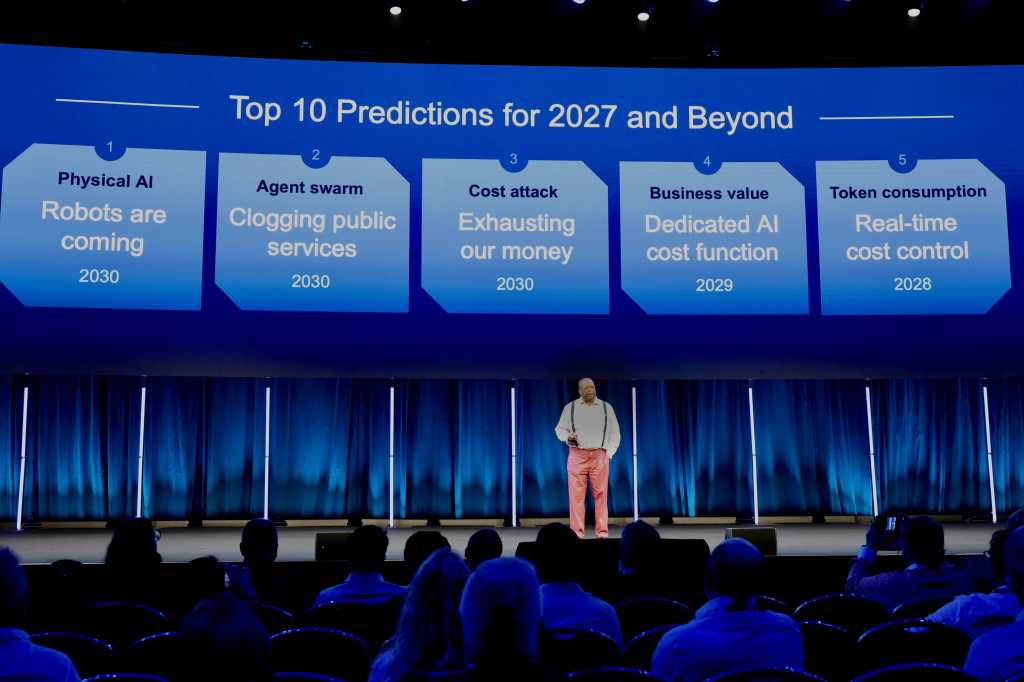
Daryl Plummer, distinguished VP analyst and Gartner Fellow, presents at the Gartner IT Symposium/Xpo in Australia in September 2026.
Gartner, Inc.