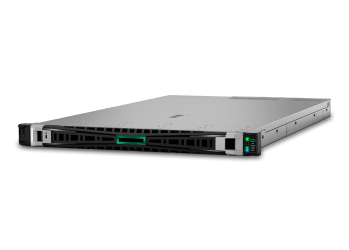
ProLiant Gen 13 portfolio includes four new high-core-density models for running heavy enterprise workloads.
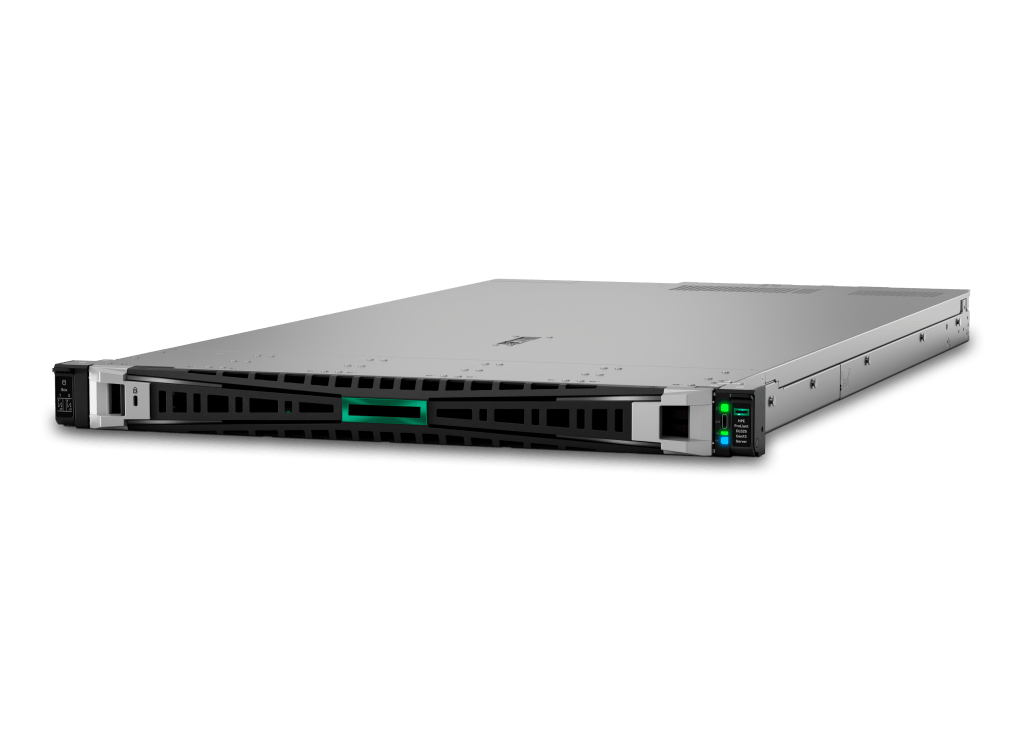
With an emphasis on high performance and embedded security, HPE is rolling out the next generation of its ProLiant server family anchored by AMD’s EPYC 9006 processor. The ProLiant Gen 13 portfolio includes four new models that boost core density, memory bandwidth, and I/O for running heavy enterprise-class workloads.
At the high end of the new server portfolio are the HPE ProLiant DL585 and DL585a.
The DL585 (pictured at top) is a single-socket 1U box supporting up to 256 cores. The high-density platform is targeted at workloads with extremely high data throughput, such as fraud detection, market-data processing, risk and pricing models, electronic design automation (EDA), simulation and AI inference, according to Carter.
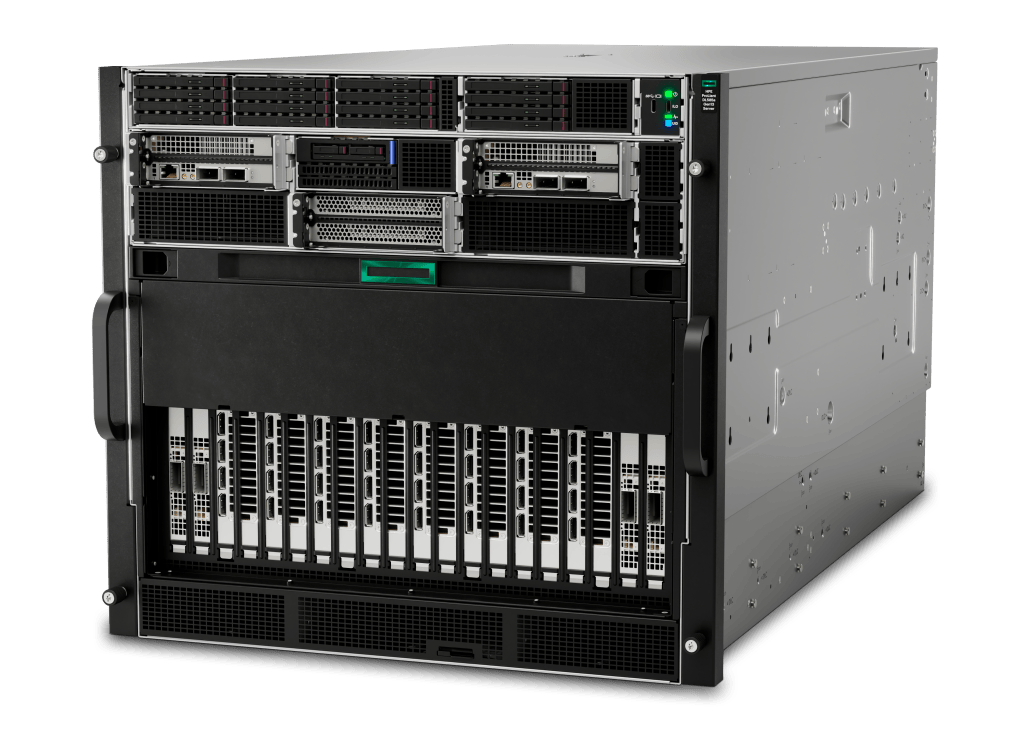
The 10U DL585a Gen13 Server (pictured below) supports up to eight double-wide PCIe GPUs and two sixth-generation AMD EPYC CPUs, connected by PCIe Gen6 links. It is designed to maximize GPU utilization, token throughput, and PCIe bandwidth for heavyweight workloads, including AI inference, virtualization, retrieval-augmented generation (RAG) model fine-tuning, analytics, and emerging agentic AI, according to John Carter, vice president of product management, HPE Compute.
HPE
The other two systems are:
- The ProLiant XD245, a one-Open Rack Unit (1OU) server with a four-node direct liquid-cooled design to deliver high compute density, powered by up to eight 6th Gen AMD EPYC Server processors.
- The ProLiant XD285, a two-Open Rack Unit (2OU), two-node, air-cooled server aimed at data center environments.
All of the new servers include support for a new version of HPE’s Integrated Lights Out (iLO) 8 management technology, which lets customers diagnose and resolve server issues, configure and manage access, and perform a variety of other automated tasks aimed at improving efficiency, according to HPE.
One important attribute is that HPE iLO 8 delivers auto-SED (Self-Encrypting Drive) server capabilities, automatically protecting data at rest from the moment the server is first powered on, according to Aaron Lamond, product marketing manager, HPE Compute. “No external key manager, additional configuration, or manual activation is required. Encryption stops being a setting someone has to remember and becomes a property of the server,” Lamond stated.
HPE iLO 8 also brings multi-party authorization (MPA), which requires two authorized users to approve high-impact actions, including key provisioning and secure erase, reducing the risk of single-user error or misuse, Lamond stated. In addition, iLO 8 supports expanded post-quantum cryptography (PQC), which extends beyond firmware to help protect server communication paths from emerging threats, Lamond said.
Enterprise-grade component verification, using HPE’s Silicon Root of Trust, validates the authenticity and integrity of critical server components as they are added, replaced, or modified throughout the server lifecycle, according to HPE.
The servers can be centrally managed via a new version of HPE Compute Ops Management cloud-based platform, which lets customers control all HPE ProLiant servers from a single console.
“HPE Compute Ops Management provides cloud-based fleet management, including low-touch onboarding that gets servers into production faster and power capacity insights that help teams plan ahead as environments scale. Integration with HPE OpsRamp Software adds workload visibility and faster remediation while Compute Copilot, part of GreenLake Intelligence, provides actionable insights to support operational decisions, HPE wrote in a blog about the news.
A new advisory intelligence capability uses agentic AI to analyze advisories against the actual server environment, establish priority, recommend remediation, and automate action before an issue becomes a disruption, HPE stated. “It does this without requiring integration with a specialized vulnerability management solution, so unaddressed advisories no longer sit quietly compounding risk across security, stability, and operations.”
HPE Compute Ops Management also automates support case creation, so any detected problems are routed to HPE support without anyone manually submitting a ticket, cutting mean time to repair and shortening the path from detection to resolution, HPE stated.
“AI is changing more than the workloads currently running in the data center. It changes how fast infrastructure must move data, how efficiently compute, memory, and I/O work together to avoid bottlenecks, and how quickly IT teams must find and close security and operational gaps across an entire fleet,” HPE wrote.
HPE ProLiant Gen13 Servers are designed for this demanding operating environment, the vendor stated. “The new generation combines security protections that activate automatically, intelligent operations that identify and remediate issues before they become disruptions, and new server architectures optimized for agentic AI, inference, and demanding enterprise workloads,” HPE stated.
The HPE ProLiant DL525 Gen13 server will be available later this year, and the ProLiant DL585a Gen13 server will be available in early 2027. The XD245 and XD285 Gen13 servers will be available in 2027.