At its Networking Investor Day, HPE shared positive growth projections for its networking businesses, including data center, campus and branch segments.
Following its record-setting third quarter, HPE said it expects cumulative AI network orders for fiscal 2026 to top $3 billion, exceeding its previous forecasts. The company also raised its fiscal 2027 networking revenue target, projecting growth percentages in the high teens to low 20s. Specific to data center networking, HPE is estimating revenue to grow at roughly 50% CAGR through fiscal 2029.
“The pace of change in the data center is, quite frankly, extraordinary. AI has fundamentally reshaped how infrastructure is designed and deployed,” Rami Rahim, executive vice president, president and general manager of HPE Networking, told analysts and others at the annual HPE Networking Investor Day. “And the reason is simple: You can invest billions of dollars into GPUs, but if the network can’t keep up with the traffic and the performance demands, those resources are not fully utilized. So, as a result, networking has become a much more strategic part of the AI infrastructure stack.”
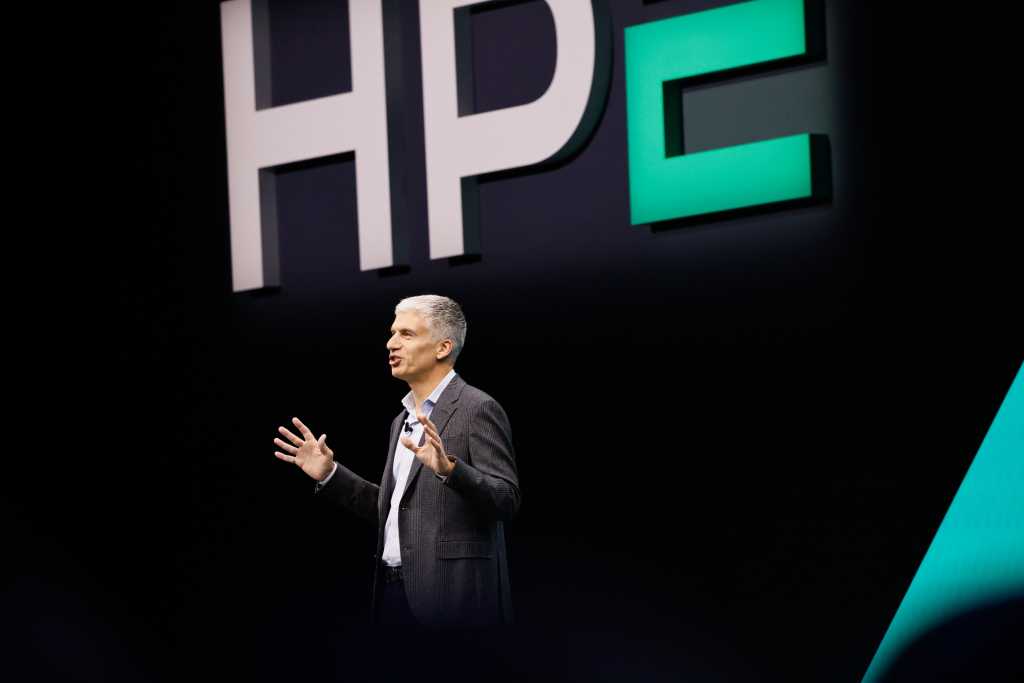
“We are taking standards-based Ethernet to a new layer of the data center stack for the first time, so it’s unlocking a massive TAM [total addressable market]. And if you think about the capacity requirements within the data center, scale-out is orders of magnitude greater than scale-across, and scale-up is orders of magnitude greater than scale-out,” said Rahim (pictured above at a 2025 event). “The capacity requirements are stunning in this area, so it unlocks a significant new TAM for us.”
Rahim pointed to HPE’s integrated AMD Helios package as an example of what an integrated Juniper/HPE will deliver. In December, HPE said it will support AMD’s Helios AI rack scale architecture with integrated scale-up Ethernet networking. The system basically will be a scale-up turnkey Ethernet package that will feature a purpose-built Juniper Networks switch based on Broadcom’s 102.4 Tbps. Tomahawk 6 network silicon and employ the Ultra Accelerator Link over Ethernet (UALoE) specification.
“We are bringing together Juniper’s networking technology with HPE’s compute, liquid cooling, rack scale engineering to deliver an integrated Ethernet-based scale-up solution. More importantly, it’s opening an entirely new addressable market in networking, either by selling our AMD Helios networking trades as part of an HPE integrated rack solution or independently to other solution providers. We believe Helios represents more than $1 billion networking opportunity over the next two years with networking trade orders having already exceeded $200 million,” Rahim said.
In addition, HPE announced this week that it won a $1.2 billion AMD Helios order from cloud infrastructure provider Vultr. “It’s HPE’s first order for the new integrated AMD Helios system, which features our new purpose-built HPE networking scale-up switch and software,” Rahim added.
Another more traditional networking area is also taking on increased importance in the AI networking arena, and that is routing, Rahim said: “As AI clusters grow beyond individual data centers, customers need to connect infrastructure across buildings, campuses, and geographies with enormous bandwidth, with low latency, and with high power efficiency. That’s where our PTX portfolio and our express silicon truly excel. The important point here is that this is not a new market we are trying to enter. We are applying decades of routing innovation, custom silicon expertise, and deep incumbency in some of the world’s largest cloud and service provider networks to a new wave of AI-driven demand. As a result, we expect our routing revenue to grow at low to high 20% CAGR from fiscal 2026 through 2029.”
Industry experts were generally enthusiastic about HPE’s strategy and presentation at the event.
“HPE’s market strategy spans a broad array of critical networking categories, including Data Center Networking, Routing, Campus & Branch, and Security. Addressing a diverse client base that ranges from traditional enterprise environments to hyperscalers and neocloud providers, the company projects significant market share gains across these key segments,” wrote Ron Westfall, vice president and practice leader for infrastructure and networking for HyperFRAME Research, in a blog post about the event. “Over the next three years, HPE expects to outpace overall industry growth rates in Data Center Networking, Routing, and Campus & Branch, positioning the unit as a high-margin growth engine for the broader enterprise.”
“We believe that HPE’s new long-term networking strategy is uniquely positioned to succeed because it pairs $800 million in expected post-Juniper cost synergies with a complete, full-stack AI architecture that tightly integrates scale-up and scale-out switching directly into high-density compute infrastructure,” Westfall wrote.
“As such, organizations must prioritize evaluating this proposition because single-vendor disaggregation eliminates the performance bottlenecks, latency risks, and integration complexity inherent in attempting to orchestrate disparate AI hardware, routing, and campus networks. Through unifying AI-native routing, Wi-Fi 7 campus modernization, and embedded zero-trust security under one operational umbrella, HPE provides enterprises and cloud providers with a future-proof foundation optimized for the demanding economics and scale of next-generation AI workloads,” Westfall wrote.
Some other observations from HPE Networking Investors Day:
Beyond the enterprise: The campus and branch market is entering a widespread, multi-year modernization cycle tied to a Wi‑Fi 7 refresh, Rahim said. He expects to see a combined Aruba and Juniper Mist portfolio, larger installed base, and global go-to-market model. Campus and branch revenue is expected to grow at a high-single-digit percent CAGR through fiscal 2029.
Network protection: As networking and security converge, Rahim said HPE continues to embed security throughout the network by combining SASE, network access control, firewalls, identity-based policy enforcement, and AI-powered operations. HPE’s security revenue is expected to grow at a high-single-digit percent CAGR through fiscal 2029.
Partners: On Nov. 1, HPE will converge the Juniper and Aruba programs under one unified partner program, HPE Partner Ready Vantage. “Partners drive most of our networking business, and this milestone will enable all 60,000 HPE partners to sell the full networking portfolio through one unified partner program. Before the acquisition, only around 10% of HPE Aruba Networking and Juniper partners overlapped, and so this creates a significant cross-selling opportunity as we bring the combined HPE Networking portfolio to a much broader set of sellers and customers.”
Service growth: “Today, services represent about one-third of our HPE Networking business. Services deepen customer relationships, add higher margin recurring revenue, and improve the quality of our products driving durable earnings,” Rahim said. HPE sees an opportunity to bring that business model and the culture to Aruba across a much larger installed base. “So, by fiscal 2028, we expect to increase services attach rates by five percentage points, supporting both recurring revenue growth and margin expansion,” Rahim said.