Vint Cerf, US CTO, Aneesh Chopra, former FCC chairman Michael Powell gather for a cozy discussion on the future of the Internet
I’m live blogging at The Digital Broadband Migration conference at Silicon Flatirons, CU Boulder. Here are a few highlight quotes from Vint Cerf’s and Federal CTO, Aneesh Chopra, keynote speech this morning.
Vint Cerf:
Started out with 4 nodes in 1969 … and now 800 billion machines, 2 billion users 5 billions moviles, I billion PCs . These are conservative. Numbers of nodes used to be easily tracked. Not now. With firewalls, mobile devices that connect episodically.
Asia has the most nodes connected, 825.1 million, and the least Internet penetration at 21%. What we do in the U.S. is not going to be definiteve, users will all come from different cultures with different traditions. Expect usage to increase of new character sets in Domain names other than Latin … Chinese, Arabic, Thai … machines today don’t have all the character sets necessary to read them.
With Ipv6 there are 40 trillion trillion addresses. Ought to be enough (at least until after I’m dead, and then its someone else’s problem) … [attendees laugh.]
If we were building the Internet today, would have done it differently. Would have built-in security mechanisms into routers that verified that other routers are who you expected them to be, verified visitor’s rights on a Website, that users could identify themselves and with each other. But if we had started out to builda fully secure system it would also have inhibited its use.
We are anticipating many more types of devices. I’m surprised by the types of devices with IP addresses: refrigerators, picture frames, IP phones … there’s an Internet enabled surfboard.The guy that invented is Dutch … must have figured that while he was waiting for th enext weave, If I had a laptop … [audience laughs].
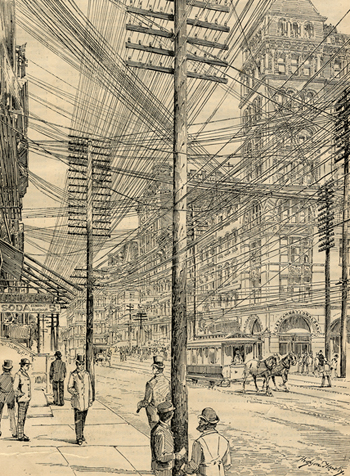
Prior to 1990’s to change ISPs, you dialed a different number. Now it requires changes to infrastructure. So we wondered, what would happen if we could buy our own pieces of Internet as users and hook it up to whatever provider we wanted? At Google we tried to build free WiFi in San Francisco. We partnered with EarthLink and we discovered that all we had won was the right to negotiate with 27 districts over the use of polls … while they argued how much they would charge for WiFi services.
[We concluded] that it’s hard to retrench or rent poles. [That houses owning Internet infrastructure could only happen for new construction.]
Internet grew in organic ways and it was designed that way. There’s no top down authority.
“Permission-less” innovation. The network is not designed to do anything in particular, just move packets. Yahoo, Google, Skype … those guys didn’t ask to permission, they just built and put up their applications.
[Something I teach my engineering students] Do not over design. If you design too specifically for an intended use, you also limit use.
Aneesh Chopra, Federal Chief Technology Officer:
The President just announced his Strategy for American Innovation [mentioned it in his State of the Union Address]. The strategy has three building blocks. [Innovation fund, particularly for wireless, overhaul health technologies and invest in innovation.]
Policy for “market-based innovation.” This is a national challenge .. to catapult areas where we need “more nudging” … innovate our way out of long-standing [problems].
Health technologies, we’re building a SmartGrid to reimburse physicians and hospitals inventions for mobile broadband, sensor networks.
Education: We’re developing a new “ARPA” for education.
In our budget, we’ve allocated …
$3 billion fund for innovation of research and applied developing of technology in public sectors.
$5 billion to build out 4G coverage to 90% of the country. WI3 … we picked an acronym to try and make it sound cool. We want to Unlock 500Mhz of spectrum, to the market, voluntary incentives [money] auctions for a win-win to those holding onto spectrum.
Build infrastructure for first responders … lack of interoperability in mobile broadband … requires reallocation of the Dblock.
[Later, in answer to an audience question, Chopra will give an example of a small radio station that makes $1 million in revenue able to sell the asset of its unused spectrum, worth $100 million, for a profitable share the proceeds.]
A new program: Startup America. For instance … did you know that companies with under $5 million in assets under management can pay management fees as high as 10% [on 401Ks]? That sucks! Giant companies pay no more than 1% in management fees. A small company captured that data from the Bureau of Labor Statistics, the Alfred Brother’s [founded Brightscope that mines the data and helps companies compare 401K plans … this is an example of the kind of innovation that can come from government/private/startup partnerships.]
Looking for ideas that agencies will fund to solve IT problems. Example, just released the first secure e-mail for healthcare providers “Health Exchange.” [The idea came from a doctor in Virginia who wrote in saying that HIPAA rules make it illegal for doctors to e-mail colleagues and patients with patient information … instead of inventing fancy new technologies can you solve that basic problem please?]
[Chopra tells of getting a group of private vendors in the room and that within 90s they had a new interoperable secure e-mail standard. Chopra says it has “spillover” applications … that’s the kind of project looking to fund.]
Investing in innovation [to solve federal government problems]. The i3 Program. We spent $650 million on the best ideas. Had a matching funds requirements. Collected 40 organizations (that would get benefit from these ideas) and gave applicants a common front door for the matching funds requirement. Had 1,700 proposals, 250 peer reviewed were determined to be good. We [had the budget] to fund 49 ideas.
[Hints that there are 251 ideas that are rated good, an opportunity for VC funding ]
Looking for feedback on the kinds of things that stifle innovation. [Like the HIPAA regulations that prevented e-mails]. We hear a lot from the [major players with filings and white papers], but we don’t hear as often from the regular guy.





