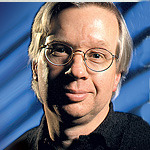
Andrew Viterbi, a pioneer in digital communications, was a runner up today in the 2008 Millennium Technology Prize, “the world’s largest technology prize”, awarded by Technology Academy Finland.
Viterbi, professor emeritus at University of Southern California, an MIT graduate, and co-founder of Qualcomm with Irwin Jacobs, was recognized for creating the Viterbi algorithm, used in millions of CDMA and GSM cell phone.
Viterbi was one of four finalists chosen in April. First prize went to Robert Langer, a Massachusetts Institute of Technology professor who works with the Harvard-MIT Division of Health Sciences and Technology, winning the $1.24 million award for his work in creating biomaterials used in controlled drug release.
The three other innovations, including Viterbi’s, were each awarded $178,000. Professor Sir Alec Jeffreys was recognized for developing the DNA fingerprinting technique, and Professor Emmanuel Desurvire, Dr. Randy Giles and Professor David Payne shared the award for their invention of the erbium-doped fiber amplifier (EDFA), which vastly increased the transmission capacity of the optical fiber networks.
Viterbi created the algorithm as a kind of teaching aid for his USC students in digital communications and information theory, trying to find a simpler way to explain to them the existing algorithms used to decipher “convolutional codes,” which were used to improve the performance of radio and satellite links. The one he created can quickly and accurate decode a multitude of overlapping signals in a digital stream, and is used in most international cell phone systems.
The math details are way beyond me, but you can pursue them on Wikipedia. The IEEE biography notes that “This concept has deeply affected information and communication theory, both for its tutorial elegance and for its applications to a broad class of communication problems.”
With others, Viterbi played a key role in developing Code Division Multiple Access (CDMA), widely used in North American cellular networks.
The IEEE has a transcript online of a 1999 interview with Viterbi.
He first got involved with the problem of signal error correction in his work at California Institute of Technology’s Jet Propulsion Laboratory, for the Explorer 1 satellite.
He is currently the president of The Viterbi Group, a venture capital company founded in 2003.





