Stop guessing and start optimizing. DCIM provides real-time visibility into power, cooling, space, and asset health to reduce costs, increase reliability, and future-proof your capacity planning.

Data center infrastructure management (DCIM) involves managing all aspects of the physical data center.
DCIM converges IT management, operations management, facilities management, and automation. DCIM tools and software monitor, maintain, and measure IT equipment, data center infrastructure, network performance, and energy consumption. This includes servers, storage, and network switches, as well as components such as power distribution and cooling.
The idea is to give data center operators a full picture of their facilities — physical space utilization, server and hardware performance, energy use, cooling functions, and more. This single view can help them understand what’s going on in their facilities to address bottlenecks, prevent future problems, optimize equipment use and placement, and plan for future needs and growth.
How does DCIM work?
DCIM software automates workflow management, provides audit trails, and helps operators identify, visualize, and manage all physical assets of a data center. These systems continuously collect and centralize data from:
- Computers and terminals
- Servers and racks
- Networking equipment like routers and switches
- Security tools and endpoint systems
- Storage systems
- Power, temperature and cooling devices
- Cable and internet lines
This data is aggregated to establish a comprehensive baseline record of all equipment, devices, and services in the data center, as well as their dependencies and interrelationships. DCIM tools can then take autonomous action or flag issues and make recommendations to improve power use, prevent future problems, and keep data centers running reliably and efficiently.
[ Related: Networking terms and definitions ]
What are the core components of DCIM?
DCIM platforms can be hosted on-premises or in the cloud as a software-as-a-service (SaaS) offering, and typically provide a simple, unified “single pane of glass” user interface (UI). Key components include the following
Data collection tools
Data is central to DCIM platforms. They require sensors and equipment that can continuously collect real-time information on equipment status, power consumption, cooling system performance, temperature and humidity levels, and other factors.
In some cases, additional software connectors, such as application programming interfaces (APIs), may be required to help peripheral devices and systems communicate with and transmit data to DCIM software.
Centralized management
All data on managed systems, devices and hardware is aggregated and stored in a central database that can be accessed by the DCIM software. The system presents data in dashboard user interfaces (UIs) via charts, graphs, maps and other detailed, easily-digestible visualizations. It also incorporates notification, alerting and tracking systems. This helps data center managers quickly identify and act on issues and trends.
Outside tool integrations
To maximize benefits, DCIM platforms can be integrated with existing management tools such as configuration management databases (CMDBs) and building management systems (BMS). This can provide a full, holistic view of the data center environment.
Additionally, integrations between systems can allow teams to collaborate, track changes, and share information about data center infrastructure.
Why is DCIM important?
Today’s data centers are more complex than ever. What used to be small storage rooms with a few racks of servers have morphed into giant facilities housing mission-critical hardware.
This only compounds legacy challenges of visibility and scope. Operators already struggle to gain a holistic view of their data centers due to disconnected systems and teams. For instance, one group may oversee and fix servers and storage systems, another may specialize in databases, yet another may be responsible for the facility itself.
Opacity is only amplified the larger and more sophisticated these systems become. It’s nearly impossible for today’s operators to gain a full view of this sprawling infrastructure. Traditional management methods are inefficient, error-prone, and can slow down IT practices (and progress) and disrupt business continuity.
DCIM provides a centralized platform to make sense of all aspects of data center infrastructure. This can help optimize processes and resources, reduce downtime and energy use, better manage multiple pieces of equipment from various vendors, and keep the business future-ready, particularly in these fast-paced days of AI.
Use cases for DCIM
DCIM platforms create a comprehensive record of all equipment, devices, and systems in operation in a data center. They incorporate details on physical spacing and location of every hardware asset, and contain materials catalogs outlining basic equipment specifications along with any dependencies, interrelationships, and departmental ownerships.
With the aid of sensors and other equipment, these systems monitor, report, and alert in real time. Bidirectional systems integration — or continuous, multi-way data exchange — helps automate changes on the data center floor and create physical-to-virtual maps that are accurate and up-to-date.
This can support a wide variety of scenarios:
Real-time data visualization and reporting
DCIM platforms working in real time and incorporating AI and machine learning (ML) tools can create interactive chats, graphs, and heat maps of data center performance. For instance, operators can track cooling usage and energy consumption, analyze specific racks, servers, and workloads, or home in on what’s causing specific bottlenecks.
Asset and connectivity visibility and management
Operators can access detailed information about the location, movement, and status of all their physical inventory, from servers, to storage devices, to networking gear. They also have access to a large library of templates outlining hardware specifications, maintenance and end of life (EoL) protocols. This can help them more accurately manage integrations, deployments, refreshes, and decommissioning.
Similarly, data center managers can track all network cables and connections to reduce latency issues and ensure that data is flowing adequately.
Capacity planning
DCIM platforms provide up-to-date, accurate information about space capacity, power and cooling use. These details can not only support existing use needs but inform growth strategies. Operators can run “what-if” scenarios to identify capacity requirements and estimate space, hardware, software, connection, and storage needs. Some DCIM software tools can also build model representations that could be tested out in digital twin or 3D environments.
All of this can help operators better predict data center life spans and support proactive management.
Change and workflow management
DCIM tools can automate time-consuming, repetitive — yet critically important — workflows, such as work orders, changes, approvals, or equipment replacements to avoid downtime or breakdowns. This can help streamline processes, while providing digital audit trails and ensuring that requests are compiled and addressed quickly and accurately.
Energy management
Energy use and management are growing concerns in enterprise. DCIM platforms can track the entire power chain via continuous monitoring, from the grid to individual devices. This can establish a baseline of existing consumption and assess power usage effectiveness (PUE) to reduce energy consumption (and therefore costs). They can also monitor temperature, humidity, and airflow to maintain peak operating conditions and efficient airflow and cooling.
Threat detection, auditing and reporting
Security is just as critical in enterprise; DCIM platforms can help here, too, detecting and blocking network threats and performing real-time incident management to protect critical, yet increasingly vulnerable, data center infrastructure.
DCIM platforms can also automate time-consuming auditing and reporting work, identifying key performance indicators (KPIs) and any discrepancies.
The benefits of DCIM
At its core, DCIM provides a real-time, highly-detailed view of data center resources, from power, to cooling, to space utilization and system health. This can provide a multitude of benefits and help operators align infrastructure decisions with business objectives.
Reduced operating costs
Data infrastructure is one of the most expensive assets in enterprise. By continuously monitoring power consumption and resource use at rack, server, and component levels, operators can pinpoint inefficiencies, right-size capacity, consolidate workloads, and automate energy-saving strategies (such as powering down during off-peak hours). This can help lower energy bills, extend the lifespan of equipment, and improve increasingly critical sustainability metrics.
Improved uptime and network reliability
DCIM tools continuously track equipment health; when coupled with predictive analytics, this can help organizations identify failures or outages before they occur. Automated alerts, real-time dashboards, and detailed reporting can speed up response times, allowing teams to be more proactive and plan for resilience, rather than putting out fires.
Smarter capacity planning
DCIM tools analyze historical usage trends, cooling demands, rack space usage, and other critical factors. This can help operators make data-driven scaling decisions. They aren’t guessing or overbuilding “just in case”; they can provision based on known uses and needs.
This can help reduce capital expenditures, avoid stranded assets, and support flexibility and workloads evolve. These factors are all particularly important in the age of AI, when training, inference, and deployment introduce unpredictable spikes in compute demand.
Centralized governance and productivity
Monitoring tools can often be fragmented across various facilities, IT, and cloud teams. DCIM can consolidate these tools into a “single source of truth” to support asset management and compliance reporting.
IT departments can remotely monitor multiple locations and edge data centers to support leaner operations. Further, automated alerts and standardized processes for equipment changes can reduce human error and free staff up for higher-value work.
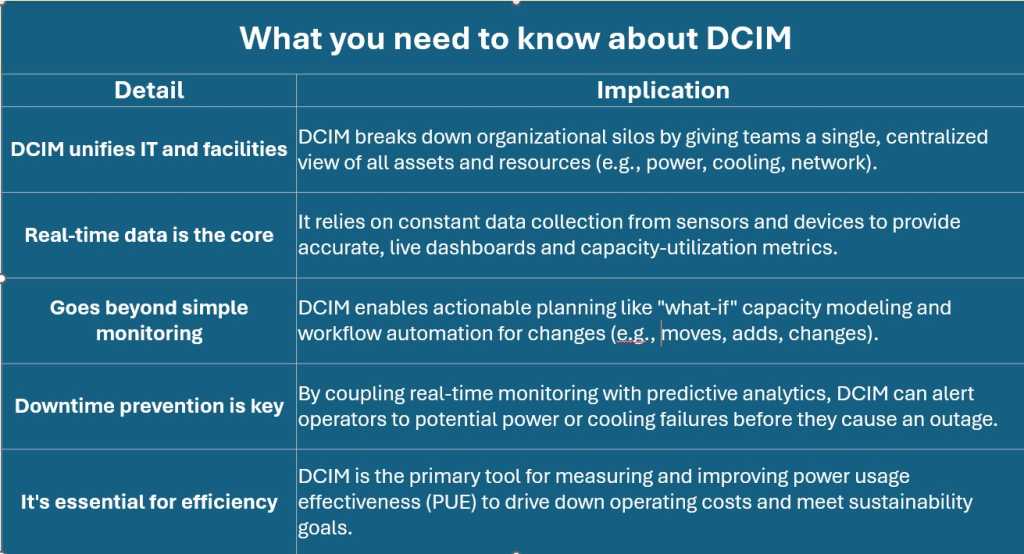
Data center information management covers a lot of ground. Here are five of the most important things you need to know about DCIM.
Foundry
Challenges IT leaders must weigh
Still, that’s not to say that DCIM is the end-all-be-all. Enterprise decision-makers should weigh their needs as they consider several critical factors.
Security risks
Because DCIM connects multiple critical systems — IT, power, and cooling assets — it can increase the number of potential entry points for attackers. Security leaders must ensure proper segmentation, access controls, and monitoring.
Compatibility and data silo issues
Integrating telemetry from different systems can be complex and costly. Data may be incompatible, potentially creating gaps, and older or legacy equipment may lack sensors (requiring expensive retrofitting) or expose data (requiring transformation pipelines that add overhead).
Enterprise leaders should consider these costs and calculate other upfront implementation investments to make sure DCIM is the right solution for them.
Skill gaps and operational discipline
While powerful and semi-autonomous, DCIM tools can take time to implement and require trained staff and consistent use for their value to be realized. Staff must be trained on processes and best practices; if cultural buy-in isn’t there or processes are immature, enterprises risk underutilizing their investment or wasting money.
Why DCIM is critical
DCIM can be a critical tool for enterprises operating increasingly complex, resource-intensive data center environments. By consolidating visibility across hardware, storage, power, cooling, and physical space, these platforms can optimize efficiency, reduce costs, right-size capacity, and extend equipment lifespan.
Automated monitoring and predictive analytics can prevent downtime; capacity planning can allow organizations to scale strategically without overbuilding. Integrated dashboards and audit trails centralize governance, helping with risk, compliance, and productivity across single or multiple data centers as well as edge environments.
Still, adopting DCIM requires careful planning. Security risks can increase as more systems are interconnected, legacy equipment can complicate data integration and drive up costs, and staff buy-in and training are essential.
As AI and automation reshape infrastructure demands, enterprises must weigh challenges while considering costs and potential gains in efficiency, reliability, and agility.