Germany’s JUPITER Booster marks Nvidia’s first 1-exaflop system on the TOP500 List, earning the fourth spot.
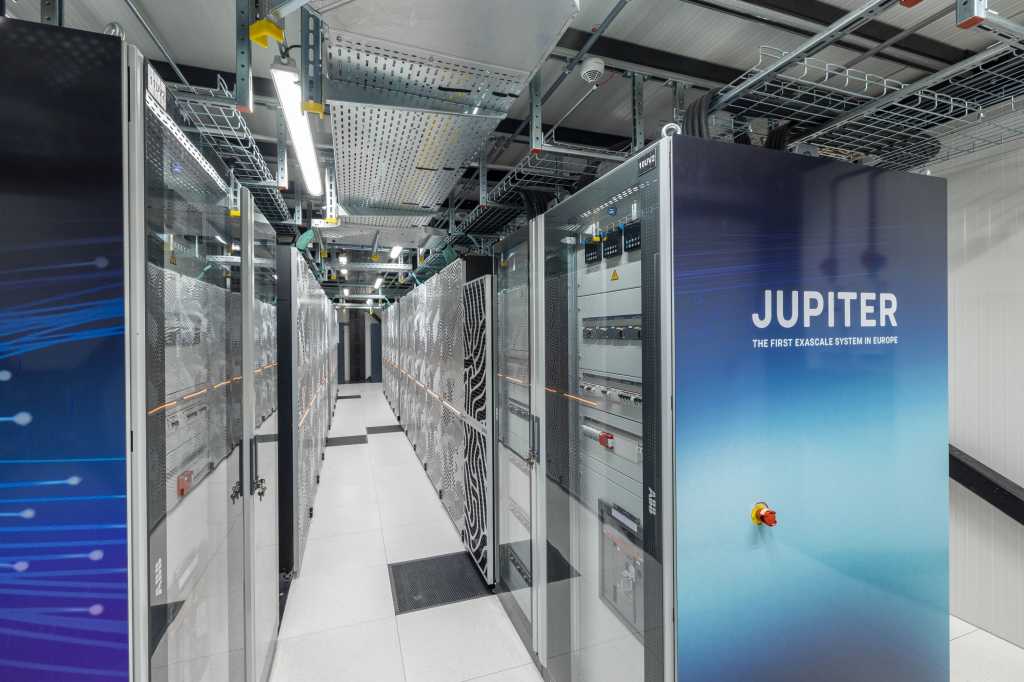
The world’s fourth exascale supercomputer has arrived, pitting Nvidia’s proprietary chip technologies against the x86 systems that have dominated supercomputing for decades. For the 66th edition of the TOP500, El Capitan holds steady at No. 1 while JUPITER Booster becomes the fourth exascale system on the list.
The JUPITER Booster supercomputer, installed in Germany, uses Nvidia CPUs and GPUs and delivers a peak performance of exactly 1 exaflop, according to the November TOP500 list of supercomputers, released on Monday. The exaflop measurement is considered a major milestone in pushing computing performance to the limits. Today’s computers are typically measured in gigaflops and teraflops—and an exaflop translates to 1 billion gigaflops. Nvidia’s GPUs dominate AI servers installed in data centers as computing shifts to AI. As part of this shift, AI servers with Nvidia’s ARM-based Grace CPUs are emerging as a high-performance alternative to x86 chips.
JUPITER is the fourth-fastest supercomputer in the world, behind three systems with x86 chips from AMD and Intel, according to TOP500. The top three supercomputers on the TOP500 list are in the U.S. and owned by the U.S. Department of Energy.
The top two supercomputers—the 1.8-exaflop El Capitan at Lawrence Livermore National Laboratory and the 1.35-exaflop Frontier at Oak Ridge National Laboratory—use AMD CPUs and GPUs. The third-ranked 1.01-exaflop Aurora at Argonne National Laboratory uses Intel CPUs and GPUs. Intel scrapped its GPU roadmap after the release of Aurora and is now restructuring operations.
The JUPITER Booster, which was assembled by France-based Eviden, has Nvidia’s GH200 superchip, which links two Nvidia Hopper GPUs with CPUs based on ARM designs. The CPU and GPU are connected via Nvidia’s proprietary NVLink interconnect, which is based on InfiniBand and provides bandwidth of up to 900 gigabytes per second.
JUPITER first entered the Top500 list at 793 petaflops, but its construction wasn’t complete. A new HPL benchmark of the completed system barely squeezed past the 1 exaflop mark.
[ Related: More Nvidia news and insights ]
Seven of the top 10 supercomputers have x86 CPUs, while three have ARM. Two supercomputers have Nvidia CPUs and GPUs, including the fifth-ranked Eagle, which is a non-exascale system owned by Microsoft and the fastest supercomputer owned by a private company.
The TOP500 metrics are rooted in measuring conventional computing performance based on the FP64 floating point data type, not AI performance, which is based on low-precision data types such as FP32, FP16, and FP8.
That has resulted in experts questioning the relevance of the TOP500 metrics, especially with the growing clout of AI in servers and applications. For example, Microsoft’s Eagle, which drives its AI infrastructure, isn’t designed for conventional computing.
With that in mind, the TOP500 editors in a press release noted the growing importance of its emerging benchmark called HPL-MxP, which is tuned to measure AI performance based on mixed precision data types. The systems typically have a higher concentration of AI accelerators.
Under HPL-MxP, El Capitan took the top spot with a recorded 16.7 exaflops, with Aurora taking second place at 11.6 exaflops. Frontier—which took second place in the mainline TOP500 benchmarks—placed third.
Also, the TOP500 list does not include high-performance systems from China, which doesn’t submit its supercomputing installations, researcher Alex Haag said in a blog entry on the U.S. Federal Reserve website.
“The data suffers from self-reporting issues, particularly in the context of China, which stopped reporting its supercomputers in 2023, leading to potential overestimation for other countries on this list,” the researcher wrote. The blog entry is related to a research paper on the state of AI in advanced economies published by Haag.
China has become increasingly secretive about its supercomputing resources following trade wars and bans on certain AI chip and high-performance CPU exports imposed by the U.S.
El Capitan took the top spot from Frontier exactly a year ago and is expected to hold the top spot for many years with no new exascale systems on the horizon. But some new systems being developed could challenge El Capitan’s dominance. RIKEN in Japan is developing the FugakuNEXT supercomputer, which will include Fujitsu’s ARM-based Monaka CPU and Nvidia GPUs. It will come online in 2030, according to a RIKEN press release.
The FugakuNEXT flagship system is designed for AI. It will succeed the Fugaku supercomputer, which is currently ranked seventh on the TOP500 list and isn’t designed for AI.
The U.S. Department of Energy is also prioritizing AI and energy efficiency in successors to its current crop of exascale computers.
Eight supercomputers with Nvidia’s Hopper GPUs took the top spots on the TOP500’s Green500 list, which measures energy efficiency relative to performance. Two supercomputers with AMD’s Instinct MI300A GPU rounded out the top 10.
Here’s a breakdown of specific details for the 10 fastest supercomputer systems on the TOP500 list for November 2025:
No. 1: El Capitan
- Location: Lawrence Livermore National Laboratory (LLNL), Livermore, Calif.
- HPL Score: 1.809 Exaflop/s
- System Model: HPE Cray EX255a
- Processors: AMD 4th Gen EPYC™ CPUs and AMD Instinct™ MI300A accelerators
- Total Core Count: 11,340,000
- Interconnect: HPE Slingshot 11
No. 2: Frontier
- Location: Oak Ridge National Laboratory, Roane County, Tenn.
- HPL Score: 1.353 Exaflop/s
- System Model: HPE Cray EX235a
- Processors: AMD 3rd generation EPYC 64C 2GHz processors
- Total Core Count: 9,066,176
- Interconnect: HPE Slingshot 11
No. 3: Aurora
- Location: Argonne Leadership Computing Facility, Lemont, Ill.
- HPL Score: 1.012 Exaflop/s
- System Model: HPE Cray EX—Intel Exascale Compute Blade
- Processors: Intel Xeon CPU Max Series processors and Intel Data Center GPU Max Series accelerators
- Total Core Count: 9,264,128
- Interconnect: HPE Slingshot 11
No. 4: JUPITER Booster
- Location: Jülich Supercomputing Centre (JSC) at Forschungszentrum, Jülich, Germany
- HPL Score: 1.000 Exaflop/s
- System Model: Eviden’s BullSequana XH3000
- Processors: Nvidia GH200 Grace Hopper Super Chip and Super Chip 72C 3GHz
- Total Core Count: 4,801,344
- Interconnect: NVLink 4 and InfiniBand NDR200
No. 5: Eagle
- Location: Microsoft Azure cluster
- HPL Score: 561.20 Petaflop/s
- System Model: Microsoft NDv5
- Processors: Xeon Platinum 8480C 48C 2GHz, Nvidia H100
- Total Core Count: 2,073,600
- Interconnect: Nvidia Infiniband NDR
No. 6: HPC6
- Location: Green Data Center Eni, Ferrera Erbognone, Italy
- HPL Score: 477.90 Petaflop/s
- System Model: HPE Cray EX235a
- Processors: AMD Optimized 3rd Generation EPYC 64C 2GHz and AMD Instinct MI250X
- Total Core Count: 3,143,520
- Interconnect: HPE Slingshot 11
No. 7: Supercomputer Fugaku
- Location: RIKEN Center for Computational Science, Kobe, Japan
- HPL Score: 442.01 Petaflop/s
- System Model: Supercomputer Fugaku
- Processors: A64FX 48C 2.2Ghz
- Total Core Count: 7,630,848
- Interconnect: Tofu interconnect D
No. 8: Alps
- Location: Swiss National Supercomputing Centre (CSCS) in Switzerland
- HPL Score: 434.90 Petaflop/s
- System Model: HPE Cray EX254n
- Processors: Nvidia Grace 72C 3.1GHz and Nvidia GH200 Superchip
- Total Core Count: 2,121,600
- Interconnect: HPE Slingshot 11
No. 9: LUMI
- Location: EuroHPC Center at CSC in Finland
- HPL Score: 379.70 Petaflop/s
- System Model: AMD Optimized 3rd Generation EPYC 64C 2GHz
- Processors: AMD Instinct MI250X
- Total Core Count: 2,752,704
- Interconnect: HPE Slingshot 11
No. 10: Leonardo
- Location: CINECA data center in the Bologna Technopole, Bologna, Italy
- HPL Score: 241.20 Petaflop/s
- System Model: Eviden BullSequana XH2000
- Processors: Xeon Platinum 8358 32C 2.56GHz
- Total Core Count: 1,824,768
- Interconnect: Quad-rail Nvidia HDR100 Infiniband
More Nvidia news:
- Nvidia highlights considerable science-based supercomputing efforts
- Nvidia touts next-gen quantum computing interconnects
- Nvidia highlights considerable science-based supercomputing efforts
- Next-generation HPE supercomputer offers a mix of Nvidia and AMD silicon
- Cisco, Nvidia strengthen AI ties with new data center switch, reference architectures
- Nvidia looks to power AI factory networks
- Should enterprise developers care about Nvidia?