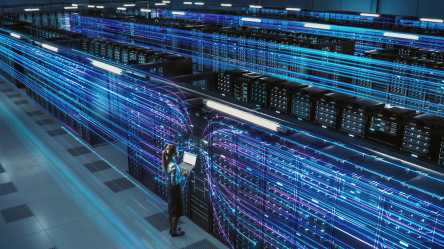
Data center capital expenditures grew 57% last year and hit a record high, according to Dell'Oro Group. Backlog figures from Amazon and Google suggest AI-fueled data center investments will continue to surpass expectations.

Data center capital expenditures grew by 57% last year to $726 billion, according to Dell’Oro Group, marking the fastest growth the research firm has recorded since it began tracking the statistics in 2014. And 2026 is looking to be similar, with an estimated growth rate of more than 50%, meaning that data center capex will cross the $1 trillion mark this year. Just a year ago, the research firm was only expecting to hit that milestone by 2029.
Data center growth has exceeded expectations, says Dell’Oro analyst Baron Fung. “The AI race is tightening,” he says. “There’s an investment race happening. AI compute costs are going up with more sophisticated architectures. And it’s across the board. Not just GPUs but infrastructure, networking, storage—and also investment in non-AI types of business.”
The four big hyperscalers—Amazon, Google, Meta, and Microsoft—increased data center capex by 76%, he says.
Based on recent earnings calls, there’s no sign that they’re going to be slowing down.
Amazon alone spent $131 billion on capex in 2025, most of it for data centers, Amazon CEO Andy Jassy told investors in February. And, in 2026, “we expect to spend about $200 billion in capital expenditures across Amazon, but predominantly in AWS, because we have very high demand,” he said.
Hyperscaler backlogs, which represent contracted future revenue, reinforce the demand for AI infrastructure.
Amazon’s backlog is now $244 billion, up 40% year over year. “There’s a lot of demand for AWS right now, in the AI space and also in the core AWS space,” Jassy said.
CEO Sundar Pichai said that Google plans to spend around $180 billion on capex in 2026. And Google also reported a backlog of $240 billion in February.
“The number of deals in 2025 over a billion dollars surpassed the previous three years combined,” said Pichai.
The driver for this growth? AI spending. AI companies need more compute capacity to train more powerful models. And enterprises deploying AI are driving demand for inference.
In survey after survey, the majority of companies say that they plan to increase their AI-related spending this year.
According to a survey of nearly 2,400 executives that Boston Consulting Group released in January, companies will double their AI spending this year, from .8% to 1.7% of revenues. And more than 90% of CEOs say that they will continue to invest in AI at current or higher levels, even if the investments do not pay off in the next year.
Downside of data center growth
All this spending on data center capacity is creating problems for enterprises looking to deploy their own infrastructure.
“Hardware prices are going up,” Fung says. “The cost of memory has gone up by double digits.”
And memory can account for as much as half the total cost of a server.
“The hyperscalers have said that part of the capex increase is attributed to higher commodity costs,” Fung says. “Microsoft called out memory specifically in their earnings call. But hyperscalers can afford to mitigate these price increases.”
Enterprise customers and smaller companies can’t match that. “So, they’re buying fewer servers, or using existing servers for a longer period until prices settle down,” Fung says.
That may push enterprises to invest more in cloud infrastructure rather than on-prem.
“There’s speculation that hyperscalers are buying up all the memory to drive up prices so there’d be more cloud usage,” he says. “But that’s just a hypothesis.”
But even without the higher cost of hardware, it would make sense for companies to deploy AI in the cloud, at least initially, he adds.
“Before you invest in any capital spending, develop in the cloud first and test your AI cloud usage to see if you can really utilize your AI hardware constantly,” Fung says. “Any idle time means you’re not getting the desired returns.”