
Hyperscalers are driving equipment shortages across the board, with no relief in sight this year. But analysts, VARs, and vendors have advice on how to keep AI and other projects moving even if you have to wait for the gear you really want.

Lead times of nine to 12 or even 18 months. Costs rising by 35%, 45%, even 50% to 200%. More than halfway through 2026, the market for IT infrastructure that’s crucial for enterprise projects, including those involving artificial intelligence, is strapped.
Memory is at the root of the shortages. Memory prices “have risen by 50% to 200%, resulting in PC prices increasing by 35% to 45% and some server prices rising over 125%,” according to Jon Forest, VP analyst at Gartner. Network switches also need memory, albeit in lesser amounts than servers, so they are not immune, with prices and lead times likewise rising dramatically.
Industry experts agree that most of the issues stem from hyperscalers gobbling up memory capacity, which trickles down to servers, storage systems, and networking devices. But while the source of the problem may be new, supply chain disruptions are far from unprecedented.
As a result, industry insiders are not short on advice on how best to deal with the situation, with tips including making better use of what you have, considering options beyond your usual scope, and lots of planning with your vendors and internal finance teams.
State of the problem
Just how bad is the current supply chain problem? “It’s pretty bad,” says Matt Kimball, vice president and principal analyst with Moor Insights & Strategy. Companies accustomed to 30- to 45-day lead times for various infrastructure are now looking at 6, 12, or even 18 months.
“It’s real, and I’m hearing it from companies of all sizes, from the 1000-server to the 10,000-server shops,” Kimball says.
“Memory costs are expected to rise sharply well into 2027 and will reach up to 25% of network hardware expenses by the end of 2027,” according to an email Gartner’s Forest sent to Network World. The figure below shows the timeline Gartner expects for memory prices, and Forest notes that the same timing applies across networking, storage, and compute infrastructure.
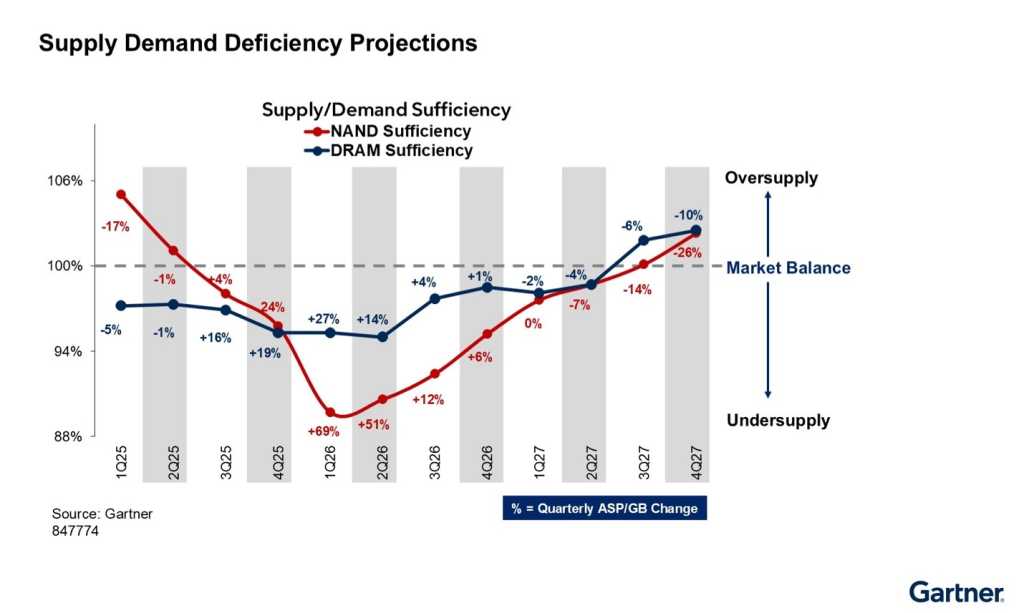
Gartner
“Enterprise network equipment pricing is projected to increase by over 20% in 2026. This upward trend is anticipated to continue with a further rise of 3% to 5% entering 2027, with no signs of price reduction until the end of 2027.”
But “reduction” will likely look more like “stabilization.”
“That’s something a lot of people don’t like to talk about. But let’s say prices went up 40%, they may come down five,” says Phillip Privett, senior vice president of vendor management with the global distributor and value-added reseller TD SYNNEX. “They’re not going to come down 40%.”
Perhaps worse, compared with past disruptions caused by issues such as fires in chip fabrication factories or the Covid pandemic, Kimball says this one is “durable” because its cause—the AI wave—is more long-lasting and just getting started.
“This AI inference wave we’re hitting is just beginning. It’s going to be longer and bigger than the training wave,” he says. “It’s impacting everything, from AI infrastructure to the traditional stuff that’s standing up your virtualization and cloud infrastructure.”
No vendors seem to be immune, not even the likes of Cisco, which makes its own Cisco Silicon One chips. Or, at least, it designs the chips; they’re actually manufactured by the Taiwan Semiconductor Manufacturing Company (TSMC), the same company that makes many of the other chips that are in such demand. And that’s only one component of many that comprise a switch.
On the other hand, the margins Cisco gets from enterprise sales are far greater than those from hyperscalers because Cisco sells mainly just hardware to hyperscalers, whereas enterprise sales generally include software and services as well. So, Cisco has incentive to keep enterprise customers happy and maintain the 66% margins it reported in Q3, its latest quarter.
Still, Cisco must deal with the same shortages as other vendors.
“I wouldn’t say any company is faring better than others,” says Neil Anderson, vice president and CTO for cloud, infrastructure, and AI solutions at World Wide Technology (WWT). “There may be nuances that some suppliers are employing to balance it to some extent, but I fail to recognize a supplier that’s not having almost the same issue.”
Cloud storage vendor Backblaze is one company that’s facing equipment cost and availability issues. “There are different types of shortages occurring in multiple places, all driven by unusual market demands, really by just a handful of very large buyers,” says James Rowell, senior vice president of operations with Backblaze.
Backblaze is constantly forecasting and monitoring demand triggers, Rowell says. That involves close alignment with the sales team to forecast client needs, as well as paying attention to historical trendlines to predict upcoming demand from new deals and growth with existing clients. But the company also looks for “unnatural market-related triggers” that would cause a spike in utilization.
With hyperscalers buying up vast amounts of capacity, “This is definitely an unnatural phase,” Rowell says. “For about for the last 12 months, I would say there’s been somewhere between a 15% and 30% uptick in costs,” especially in terms of servers and compute disks.
On the positive side, at least for Backblaze, the company is also seeing an uptick in business from an interesting source: AI companies. “We reported in the last earnings period a 70% increase in AI companies using our platform,” says Patrick Thomas, vice president of marketing at Backblaze. “That’s massive.”
On top of that, the company is seeing an uptick in deals from enterprises that can’t get the storage capacity they need or want on-prem. “There’s a general market nervousness where we’ve got potential deals coming our way because those organizations are concerned about being able to do it themselves,” Rowell says.
While some expect new chip fabrication plants currently under construction will ease memory supply constraints, Privett doesn’t buy it. “I don’t see it getting better anytime soon,” he says. “Building a new fab is a two-year process.”
Advice: Start with the basics
Enterprises, then, must play the cards they’re dealt. For Moore Insights’ Kimball, who did stints as an IT exec with the states of Florida and Oregon, that starts with making the most of what you have.
Such a strategy is “shockingly not implemented much” across the companies he sees. “A simple capacity planning exercise can free up a lot of resources.” That includes virtualized servers running at just 20% to 30% utilization as well as extending the life of existing servers. While 15 or 20 years ago it was common to refresh every four years or so, companies can often get six or seven years out of today’s servers.
While such strategies won’t solve your AI compute challenges, they can certainly help support your ongoing operations and free up budget for AI and other modernization projects, he says.
“Sweat your assets,” agrees Privett of TD SYNNEX. “Work them as much as you can, add only what you need, get extensions on your licensing, renewals on your services agreements and things like that. Just sweat it out a little longer.”
If you have budget to spend but can’t get the hardware you’re after, buy something else, says WWT’s Anderson. “Look at things that are not tied to those components, like software projects or SaaS licensing,” he says.
Get friendly with finance teams
Numerous experts recommend regular meetings with your CFO or finance teams to keep them apprised of what you’re up against so the company can plan accordingly.
Gartner’s Forest advises using rolling 12- to 24‑month forecasts and engaging early with suppliers to identify constrained components and SKUs. Committing to quarterly or monthly buys can help you avoid long-term agreements that extend past the rapid increases we’re seeing in 2026, he says.
Also engage with the financing arm of your equipment vendors, some of which are offering financing incentives, Privett says. Compute vendors in particular are offering subsidized financing, deferred payments, and low-cost financing for the first year or so. “Those are huge opportunities to take advantage of,” he says.
By engaging with finance teams, IT groups can conduct budget allocation exercises and try to come up with ways to make the financials work. The last thing you want to do is surprise them with additional budget requests out of the blue.
Kimball recalls his days with the state of Florida, when all budget requests were examined by a technical review working group—which was designed to be hostile.
“I can’t imagine going to them and saying, ‘Oh, did I say that was a million dollars? It’s actually $2 million. I need you to write me a bigger check,’” he says. “I would walk into one of the swamps in Tallahassee and get eaten by the alligators instead of doing that.”
Work with your vendors and VARs
As you put plans together, lean on your vendors for help, including channel partners such as value-added resellers (VAR) and national resellers. “Work with them to map things out and understand what your workloads will look like,” Kimball says.
That’s what Backblaze’s Rowell regularly does with his suppliers. He lays out his forecast for the year, with commitments on what Backblaze will definitely buy, as well as scenarios that account for rapid growth, say, 2x. “And they’ll come back with, ‘Well, okay, no problem,’ or maybe they say we need to put in an allocation right away, or we won’t be able to get what we may need,” he says.
Similarly, he sits down with his CFO regularly to map out predictive models that factor in inflation, price hikes, and the like. The idea is to plan out multiple scenarios, so you don’t get blindsided.
“If you don’t do that, you’ll get caught with your pants down, on the upside-down end of spectrum,” he said – meaning not having the capacity to take advantage of market opportunities.
Acquiring the capacity you need to meet project demand may also mean being flexible in terms of your equipment choices. If you’re a Dell shop but can’t get Dell servers, maybe you go with Lenovo, Kimball says.
“You’ve got to figure out how to use all this silicon and infrastructure in a heterogenous way to serve your needs,” he says. That’s especially true when it comes to AI infrastructure. “If you think you’re going to go with 100% Nvidia for everything from RAG [retrieval augmented generation] to inferencing at the edge, you’re kind of crazy, not because of cost but because of availability.”
Look at alternatives, including AMD and cloud solutions, while staying mindful of how it all plays together. You may not be able to get Nvidia GPUs, but AWS, Azure, and Oracle Cloud have them, Kimball notes.
Be strategic, perhaps by using cloud offerings to handle certain tuning or inference workloads, then bringing them back in-house when appropriate. “Have a better understanding of what absolutely has to be on prem and what can be in the cloud,” he says.
That’s good advice, says Backblaze’s Thomas. When it comes to AI, think about performance tiers and the range of use cases you have. They don’t all need top-tier performance.
“People get wrapped around axle of needing the top end. There’s a lot of flexibility in the edges, innovation in different hardware and software,” Thomas says.
Gartner likewise advises companies to increase configuration flexibility and expand sourcing paths. That may include buying from secondary markets and lease-return programs to preserve continuity with existing infrastructure until the shortages pass, Forest says.
Get started somewhere
Even if you can’t acquire or have to wait for the infrastructure you need, don’t let that keep you from getting started with AI or other modernization projects.
Options include public cloud and neocloud providers, Anderson says. WWT also provides capacity in its own lab so customers can get started with proof-of-concept projects. “Don’t just throw your hands up. We can help you find access to capacity,” Anderson says. “Production-scale AI may be delayed, but don’t let that derail your strategy.”
Colocation providers may likewise be an option, especially if enterprises are struggling to acquire high-end networking equipment. Networking is a key value proposition for colocation providers, in that they have built-in connections to various cloud providers and other ecosystem players.
Equinix, for example, has 280 data centers in 77 metropolitan areas, says Phil Read, senior director, colocation product management for the company. If you have the compute infrastructure, Equinix can help you with the high-end connectivity required both intra- data center and at edge facilities.
It also has partnerships with the likes of Cisco and Nvidia for “ready-to-go AI connectivity,” Read says. That means Equinix offers the right infrastructure to meet the requirements of high-end compute solutions in terms of power density and cooling. Such power densities are significant, requiring 120k VA per rack and up. “There’s plenty of talk about a megawatt rack,” he says.
Power is a significant issue in this entire discussion, Privett says. Older installed computing infrastructure likely consumes far more power than newer systems, which is an argument for upgrading as soon as possible.
“If you modernize today, you could substantially reduce the number of servers needed to support the same applications at a much lower power consumption rate,” Privett says. He advises sitting down with folks from the OT side of the house to make sure power is available for whatever you want to do. In many areas, power is at a premium.
If your plans include installing GPU environments in your own data center, WWT advises you not to delay. “We’re telling customers, you need to talk with us and get that designed, get that ordered, because it will take quite a bit of time until it actually ships and we’re able to install it,” Anderson says.
Moor Insights’ Kimball agrees. “You have to order these parts today if you want to see them hitting your dock, your warehouse, or your office 12 months from now.”