One of the most fundamental units of networking are the interconnect networking technologies — the protocols and frameworks that enable one device to connect to another in a standardized way. In modern data centers interconnect technology has come under more pressure than ever before, thanks to AI.
The race to build massive AI systems capable of training trillion-parameter models has created an unprecedented bottleneck: moving data fast enough between thousands of accelerators has proved challenging. Without efficient interconnects, even the most advanced AI models would stutter, as those bottlenecks in data movement cripple the parallel processing essential for training large language models (LLMs) like those powering generative AI.
The challenges of AI networking
The demands of AI are reshaping interconnects. Traditional networks, designed for general-purpose computing, struggle with the unique requirements of AI workloads. AI training and inference create fundamentally different networking challenges compared to traditional data center applications. The scale and communication patterns of modern AI systems push interconnect technologies beyond their original design limits.
How AI differs from traditional workloads:
- Communication pattern: Traditional apps use client-server traffic; AI uses all-to-all communication where every GPU talks to every other GPU simultaneously
- Bandwidth scaling: Doubling AI model parameters can quadruple network traffic due to gradient synchronization across thousands of accelerators
- Latency sensitivity: Sub-microsecond response times required for training synchronization vs. millisecond tolerances for typical applications
- Traffic volume: Large training clusters generate constant data flows that dwarf peak traditional HPC traffic
The Core Trio: Ethernet, InfiniBand, and Omni-Path
In 2025 there are effectively three core data center interconnect networking technologies to consider: Ethernet, Infiniband and Omni-Path.
Ethernet accelerates toward terabit speeds with AI optimizations
Ethernet, the decades-old standard, has long dominated enterprise data centers for its compatibility, cost-effectiveness and scalability. In AI contexts, however, vanilla Ethernet falls short due to higher latency and packet loss in high-traffic scenarios.
[ Related: Inside the AI-optimized data center ]
A number of recent changes have helped to push Ethernet forward, advancing its capabilities to better meet the needs of AI.
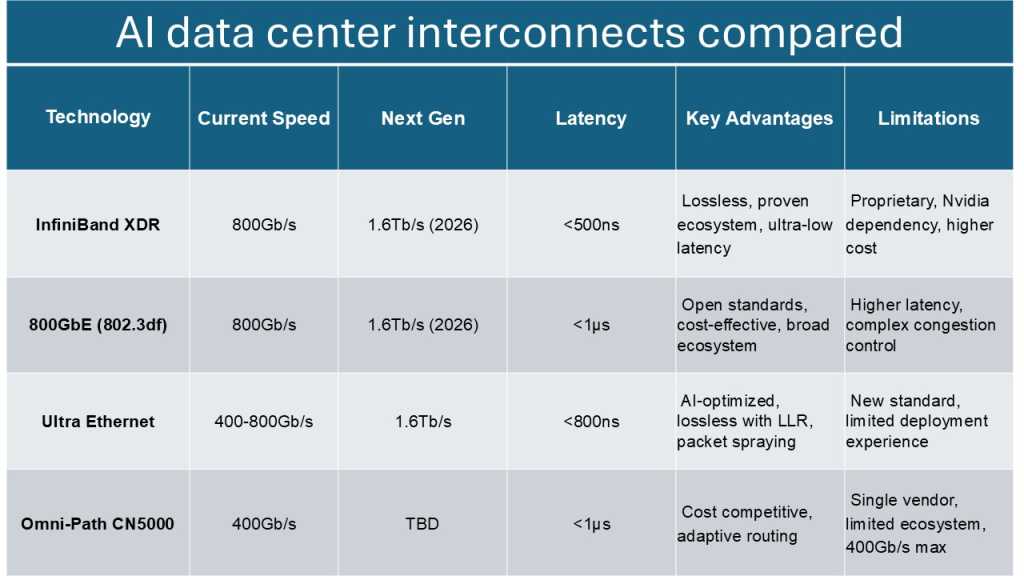
IEEE 802.3df-2024. The IEEE 802.3df-2024 standard, completed in February 2024 marked a watershed moment for AI data center networking. The 800 Gigabit Ethernet specification provides the foundation for next-generation AI clusters. It uan 8-lane parallel structure that enables flexible port configurations from a single 800GbE port: 2×400GbE, 4×200GbE or 8×100GbE depending on workload requirements. The standard maintains backward compatibility with existing 100Gb/s electrical and optical signaling. This protects existing infrastructure investments while enabling seamless migration paths.
UEC 1.0. The Ultra Ethernet Consortium represents the industry’s most ambitious attempt to optimize Ethernet for AI workloads. The consortium released its UEC 1.0 specification in 2025, marking a critical milestone for AI networking. The specification introduces modern RDMA implementations, enhanced transport protocols and advanced congestion control mechanisms that eliminate the need for traditional lossless networks. UEC 1.0 enables packet spraying at the switch level with reordering at the NIC, delivering capabilities previously available only in proprietary systems
The UEC specification also includes Link Level Retry (LLR) for lossless transmission without traditional Priority Flow Control, addressing one of Ethernet’s historical weaknesses versus InfiniBand. LLR operates at the link layer to detect and retransmit lost packets locally, avoiding expensive recovery mechanisms at higher layers. Packet Rate Improvement (PRI) with header compression reduces protocol overhead, while network probes provide real-time congestion visibility.
InfiniBand extends architectural advantages to 800Gb/s
InfiniBand emerged in the late 1990s as a high-performance interconnect designed specifically for server-to-server communication in data centers. Unlike Ethernet, which evolved from local area networking, InfiniBand was purpose-built for the demanding requirements of clustered computing. The technology provides lossless, ultra-low latency communication through hardware-based flow control and specialized network adapters.
The technology’s key advantage lies in its credit-based flow control. Unlike Ethernet’s packet-based approach, InfiniBand prevents packet loss by ensuring receiving buffers have space before transmission begins. This eliminates the cascade failures that can occur when packets are dropped in large AI training jobs.
InfiniBand’s evolution to XDR (eXtended Data Rate) maintains its architectural advantages while scaling to match Ethernet’s bandwidth capabilities. The IBTA Volume 1 Release 1.7 specification, released October 2023, defines 800Gb/s per port with 1.6Tb/s switch-to-switch connections using 200Gb/s per lane SerDes technology. XDR switches target sub-500 nanosecond latency while supporting up to 500,000 endpoints with near-linear performance scaling.
Omni-Path revival targets cost-competitive AI networking
Intel developed Omni-Path in the mid-2010s as a direct challenge to Nvidia’s InfiniBand dominance in high-performance computing. The technology featured adaptive routing, integrated fabric management and competitive performance, but Intel abandoned the effort in 2019 as it refocused on core processor businesses.
The technology found new life when the original Intel Omni-Path engineering team spun out to form Cornelis Networks in 2020. The company has revived Omni-Path with the CN5000 series, targeting 400Gb/s AI deployments with a focus on cost advantages over Nvidia solutions.
Cornelis targets price-sensitive deployments where cost-performance optimization matters more than absolute performance. However, the technology faces an uphill battle against established interconnects backed by broad vendor ecosystems and extensive software optimization. The company promises dual-mode capabilities in future CN6000 generations, supporting both native Omni-Path and Ethernet compatibility.
Technology comparison: specifications and performance
Foundry
As AI reshapes industries, interconnects like Ethernet, InfiniBand and Omni-Path are the silent enablers, evolving from mere data pipes to intelligent fabrics.
While InfiniBand leads in performance, Ethernet’s openness and Omni-Path’s revival promise a more democratized future. Hyperscalers’ strategies underscore a hybrid approach, balancing innovation with economics. In this neural revolution, the real intelligence may lie in the connections between nodes.