
The new generation of Amazon’s Just Walk Out technology taps RFID to expand use cases.
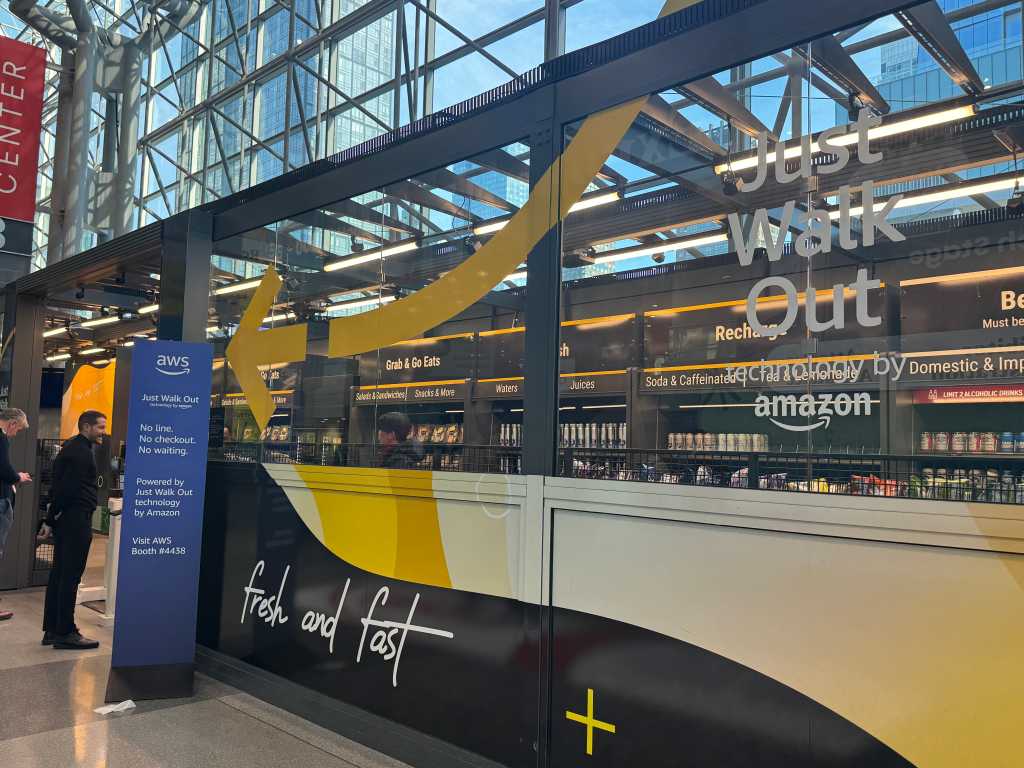
In sporting venues, airports and other high-volume retail sites, no one wants to wait in long queues. Customers, fans and patrons don’t want to miss the sporting action or be late getting to their gates. Over the last few years, Amazon has rolled out its Just Walk Out (JWO) technology to third-party locations across the country. JWO makes “grab and go” a literal term: Tap a credit card, enter a kiosk or store, grab some items, walk out, and your credit card is charged.
JWO uses camera vision to see what consumers are picking up and taking with them. It’s extremely accurate. I’ve personally gone into stores and tried to confuse it by picking up items, putting them down, switching them, etc., but I haven’t seen it made a mistake.
The use of cameras makes JWO ideal for packaged goods like water, beer, candy bars, and chips—items with rigid shapes and consistent packaging. However, soft goods such as clothing and fan gear pose challenges for computer vision tracking because they can fold, stretch, drape, and be tried on or carried bundled.
At the National Retail Federation’s annual event in New York early this month, Amazon showed the next generation of its JWO checkout lanes, which use RFID to recognize items.
Just Walk Out RFID
Unlike camera-based JWO, which requires the deployment of cameras to be connected to a back-of-house system, the RFID JWO checkout lanes are fully self-contained and can be deployed in a variety of environments. This makes it ideal for traditional use cases, such as merchandise stores in stadiums, as well as for pop-up shops, festivals, concerts, and other temporary retail locations. Another benefit is that the portable RFID checkout lanes can be deployed in hours instead of weeks. They also add features that let consumers see what they’re being charged before they pay, while helping retailers reduce merchandise theft.
At NRF, I talked with Nathan O’Neill, director of technology for Just Walk Out at AWS, and he explained the key advantage of RFID lanes: “All of the compute is built into the lane itself. It only needs either Wi-Fi or a wired ethernet connection—there’s no backroom infrastructure at all. We usually have a small gateway in the ceiling, but that’s it. You don’t need a back room or MDF network room.” This makes the technology much easier to deploy for temporary venues.
The new RFID lanes are built for merchandise and apparel. These items are much harder to track with camera-based systems since they can be folded, stacked, or carried out of a store in bulk. RFID tags solve that problem by identifying every item. The lanes combine several systems working together at the point of exit. Each lane is equipped with multiple RFID antennas positioned along both sides, which begin reading item tags as a person approaches. Those reads are processed by technology built directly into the lane, eliminating the need for a separate back room or server rack.
A screen inside the lane shows the items detected and the running total. Consumers can finish their purchase by tapping a credit card and exiting the lane. Motorized gates control entry and exit, opening once payment is complete. Cameras are also used alongside RFID, primarily to handle exceptions. For example, they can detect when a person is carrying an item without a readable tag. The system flags this type of transaction, and then a store associate can get involved.
Store associates still play an important role
The technology isn’t meant to eliminate associates, but rather shift their role. O’Neill clarified: “Instead of an associate stopping every checkout, you can have them helping people find what they’re looking for in the store, like a particular t-shirt someone saw online. The goal is to be able to change what associates are doing in the store.”
The lanes themselves are designed to be mobile. They sit on caster wheels, use standard power, and require only a network connection. After several iterations, Just Walk Out has become easier and cheaper for retailers to adopt, Amazon claims. Installation times have dropped from weeks to hours, and deployment costs are also down. In 2025, the new generation of RFID lanes were implemented at 17 pilot locations, including a pop-up at the Camp Flog Gnaw music festival.
While speed of deployment is important, the bigger driver for Amazon is to improve accuracy and reduce theft. As O’Neil acknowledged: “I don’t think anything is 100 percent foolproof.” Even so, he said, the new RFID-based approach is more accurate and more effective than traditional checkout and loss-prevention methods.
Final thoughts
I’ve long been a fan of Just Walk Out and have used it in many venues including Lumen Field in Seattle, Harry Reid International Airport in Las Vegas, and at the Javits Center in New York during the NRF show. The ability to pick up merchandise and leave does require a bit of a mental hurdle. The first time you use it, you might worry about accurate billing. However, after using it a couple of times, that doubt goes away. The RFID lanes add features and streamline deployment —customers can quickly grab merchandise and get back to their seats or other activity instead of having to wait in line.





