The joint architecture combines AMD’s Ryzen AI Halo hardware and a variety of Cisco technologies, including AI Defense for model and agent security, DefenseClaw for security policy enforcement, and Cisco Cloud Control to unify policy and control.

Cisco and AMD have expanded their partnership with a new package of hardware and security software that’s designed to help enterprise customers protect, deploy, and manage distributed AI resources.
During AMD’s Advancing AI event this week, Cisco’s president and chief product officer Jeetu Patel took to the stage to talk about how AI inference will be widely distributed and will require an architectural stack of software and tools that Cisco and AMD are partnering to develop.
The joint architecture combines AMD’s compact, high-performance Ryzen AI Halo hardware and a variety of Cisco networking, observability, governance, and security technologies. “AMD provides the deskside/local AI platform. At the foundation is AMD Ryzen AI Halo hardware, an isolated agent sandbox and the services needed for local-first inferencing, including model routing and token limits via AMD’s Semantic Router and local inference on Lemonade,” wrote Cisco’s Yash Sheth, senior director, engineering and research, in a blog post about the new package.
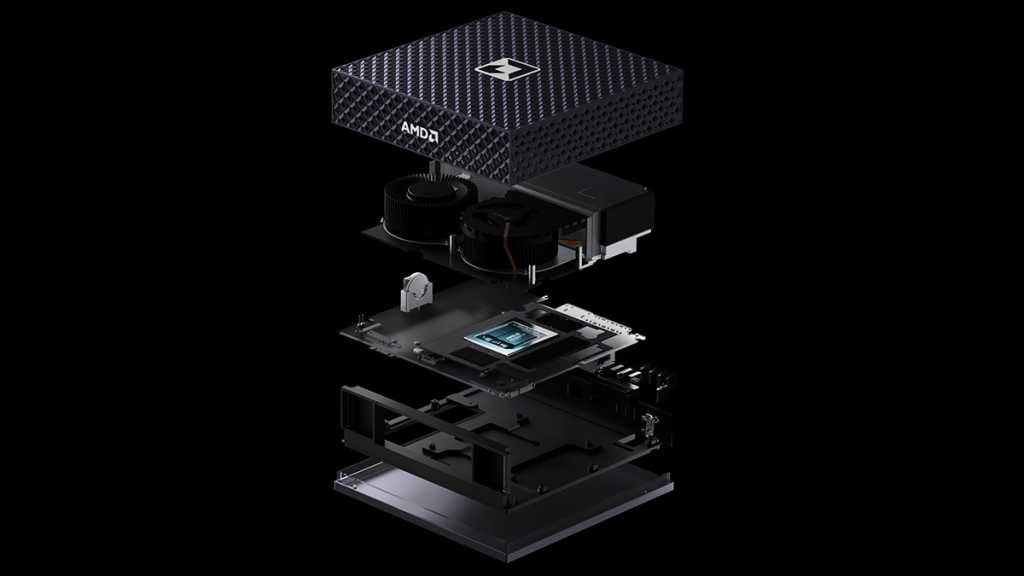
Ryzen AI Halo (pictured below) is designed to support local AI inference on an AI PC using its CPU, GPU, and XDNA neural processing unit (NPU), according to AMD. A resilient AI platform should continue delivering useful AI services even when connectivity is limited, models need to change, or workloads shift, AMD stated.
AMD
Cisco then wraps that platform in a secure harness that includes its Splunk Agent Observability plus Splunk Infrastructure Monitoring to provide full-stack observability, tracking agent behavior, tokenomics and compute operation, according to Sheth.
Cisco also brings its AI Defense for model and agent security; DefenseClaw for security policy enforcement, so guardrails are enforced directly on-device, within the agent harness; and Cisco Cloud Control offering a single pane of glass for unified policy and control, Sheth stated.
“To make deskside and local AI computing work at enterprise scale, every AI node must be treated as a secure, managed node in the enterprise network,” Sheth wrote.
“The need for token efficiency and data sovereignty is driving a new class of computing, deskside computing, with users and teams putting AI agents right by their sides,” Sheth wrote. “Inference is moving to a hybrid architecture with thousands of ambient deskside agents in an enterprise helping employees have 24×7 productivity. That’s an extraordinary opportunity. It’s also a brand-new operating challenge.”
As agentic AI moves from experimentation to real enterprise workflows, organizations need more than powerful endpoints. AI agents can run continuously and act on enterprise data, but create new requirements for network infrastructure, tokenomics, agent behavior, and security, according to a statement from AMD.
“Running more AI locally can help improve responsiveness, keep sensitive data closer to users, and reduce dependence on cloud-only approaches, but enterprises also need a way to monitor and manage these systems at scale. AMD and Cisco are addressing that gap by collaborating to pair high-performance local AI compute with the observability, governance, and control infrastructure needed for enterprises to deploy it responsibly,” AMD stated.
“By combining AMD Ryzen AI Halo systems and our broader local AI software capabilities with Cisco’s enterprise networking, observability and security technologies, we are helping customers deploy AI in a way that is performant, secure, observable and manageable at scale,” said Jack Huynh, senior vice president and general manager, computing and graphics group with AMD, in a statement.
A few other interesting statistics and trends cited during AMD CEO Lisa Su’s keynote at the Advancing AI event include:
- AI adoption is accelerating across all industries, with agentic AI driving a surge in compute demand and shifting workloads from training to inference, which accounts for 60% of global AI compute capacity in 2026.
- AI is moving beyond the cloud, with edge and personal devices becoming critical for real-time, distributed intelligence.
- The AI accelerator market is projected to reach $1.4 trillion by 2030, nearly tripling previous forecasts, with GPUs expected to dominate but CPUs gaining new growth vectors due to agentic AI.
- Server CPU market is forecasted to grow over 50% to $200 billion by 2030, fueled by rapid agentic AI adoption and the need for massive CPU infrastructure.