The open-source project from LF Networking allows organizations to leverage their current AI/ML platform investments while gaining networking-specific capabilities that general-purpose platforms cannot provide effectively.

Back in April, Infosys helped to start the Essedum open-source networking project for AI at the Linux Foundation’s LF Networking (LFN) division.
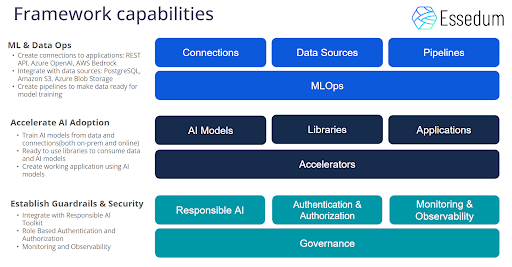
This week the project hit a major milestone with its 1.0 launch. Essedum Release 1.0 is an open-source platform designed specifically to accelerate AI integration in networking environments. Essedum provides a framework spanning data ingestion, pipeline orchestration and model deployment across on-premises and cloud environments. In addition to code contributed by Infosys, Essedum also integrates components from the LFN AI Task Force’s Data Sharing Platform.
The initial release delivers seven core technical capabilities:
- Connections: Establish secure communication links between software systems to enable data exchange and integration across environments.
- Datasets: Ingest and manage data from multiple sources including storage buckets, MySQL databases and REST APIs.
- Pipelines: Build and manage both training and inferencing workflows for AI/ML workloads, including model fine-tuning and deployment.
- Models: Access and manage AI models from configured connections across platforms including AWS SageMaker, Azure ML and GCP Vertex AI.
- Endpoints: View and manage all connected endpoints, including REST APIs and model services, from a centralized interface.
- Adapters: Simplify integration with external services without needing to configure host details.
- Remote executor: Run pipelines or programs on remote servers or virtual machines to optimize compute-intensive processing.
“The goal is to have a thriving community of developers and a rich set of reusable components that make building AI-powered network solutions a standard, accessible practice, rather than a bespoke engineering effort,” Ranny Haiby, CTO, networking, access, edge at the Linux Foundation, told Network World.
Why Essedum is a game changer for AI networking applications
Building AI-powered networking applications is typically a complex, time-intensive process requiring teams to stitch together disparate tools. While general-purpose machine learning platforms like MLflow and Kubeflow provide machine learning lifecycle management, they lack the domain-specific components needed for telecommunications and network management use cases.
Essedum is positioned as a specialized integration framework that orchestrates existing tools rather than replacing them. It’s an approach that allows organizations to leverage their current AI/ML platform investments while gaining networking-specific capabilities that general-purpose platforms cannot provide effectively.
“Essedum is not a replacement for existing AI/ML platforms like MLflow, Kubeflow, or vendor-specific solutions,” Haiby explained. “Instead, it acts as a specialized integrating framework for the networking domain.”
Essedum simplifies this entire workflow by providing a unified and comprehensive framework that contains all the necessary components in one place. Specifically, he noted that it offers networking teams:
- Easy access to AI building blocks: Essedum makes it simple to access and integrate the different layers required to build AI applications for networking. This includes tools for data sharing and preprocessing, domain-specific AI models, and a framework for building the applications themselves. This structured approach eliminates the need for teams to source, validate, and integrate these components individually.
- Reduced development time: By providing a ready-made platform with pre-built tools and libraries, Essedum significantly shortens the time to develop AI-powered solutions. Teams can focus on the specific networking problem they want to solve rather than on the foundational engineering work. This accelerates innovation and allows teams to deliver value more quickly.
“With Essedum, networking teams can now build and deploy AI applications for networking much faster and more easily than before,” Haiby said.
Production-ready sandbox environment demonstrates deployment viability
Beyond the code release itself, LF Networking has deployed Essedum in a fully operational developer sandbox environment through partnership with the University of New Hampshire Interoperability lab.
“Building on the initial code drop, our next priority was to ensure the code is not just available, but also functional in a real-world setting,” Haiby said. “I’m pleased to report that the code was successfully deployed and is now fully operational in a developer sandbox environment.”
The sandbox provides developers with hands-on access to test the platform’s capabilities in realistic scenarios while demonstrating the platform’s production readiness and deployment reliability across different infrastructure configurations.
The operational sandbox also serves as a validation environment for the platform’s multi-cloud deployment capabilities. The deployment demonstrates that Essedum can function effectively across different infrastructure environments while maintaining consistent performance and functionality characteristics that networking teams require for production deployment scenarios.
Community-driven development roadmap targets operational transformation
LF Networking’s development strategy for Essedum emphasizes community-driven enhancement.
“Our 18-month roadmap is focused on moving Essedum from a foundational release to a tool that transforms how network operations teams work day-to-day,” Haiby said. “The key to this transformation is developer onboarding and community enrichment.”
The strategy reflects the open-source principle that widespread adoption and diverse contributions create better, more robust software than centralized development. This approach becomes particularly important for domain-specific platforms where user requirements, operational contexts and use cases may vary significantly across different networking environments, organizational structures and technical constraints.
“As developers build applications, we expect to see a virtuous cycle of contribution,” he said. “The core team will work closely with the community to identify common functions and components, such as specific data preprocessing pipelines, AI models for anomaly detection, or network-specific agents and bring them back into the main project.
The technical roadmap includes several key enhancements planned for the coming months. Docker and Helm-based deployment automation will streamline cloud-native deployments and container orchestration. Ingestion support for PDF and Excel files will accommodate common networking documentation and data formats used in network planning and operations. Secrets management capabilities will address secure credential handling requirements in enterprise environments. Enhanced role-based access control will support multi-team deployment scenarios. Expanded public cloud platform support will ensure broad infrastructure compatibility across different organizational technology stacks.
“As more real-world applications are built with Essedum, we will gather critical feedback to refine the project to learn what works, what needs improvement, and what new features are required to truly transform network operations,” Haiby said. “This feedback loop will guide the project’s evolution, ensuring it remains relevant and impactful.”
Linux Foundation