Learn how companies like Cisco, Nvidia, Arista, HPE Juniper, and Extreme Networks are transforming data centers into specialized AI factories.

Artificial intelligence (AI) infrastructure spending is continuing to skyrocket, which is having a dramatic impact on networking equipment.
The stakes are enormous. Data center spending is projected to hit $1.1 trillion by 2029, up from $430 billion in 2024, with networking representing a critical bottleneck.
On the networking hardware side, data centers are rapidly being transformed into specialized AI factories optimized for intensive computational tasks like model training, inference, and real-time analytics. In that growing market, multiple networking vendors are vying for share to meet the requirements of AI in networking.
The winner will be determined not just by raw speed, but by solving AI’s unique challenges: lossless transport for GPU synchronization, adaptive routing to avoid congestion hotspots, microsecond-granularity telemetry and management simplicity for clusters scaling to 100,000+ accelerators. A single slow GPU link or network failure can reduce cluster performance by up to 40%, making reliability critical.
The landscape is evolving rapidly. Ethernet is gaining ground against InfiniBand with the Ultra Ethernet Consortium 1.0 specification finalized in June 2025, while silicon photonics promises to revolutionize power efficiency. 800G is becoming table stakes with 1.6T platforms arriving by year-end.
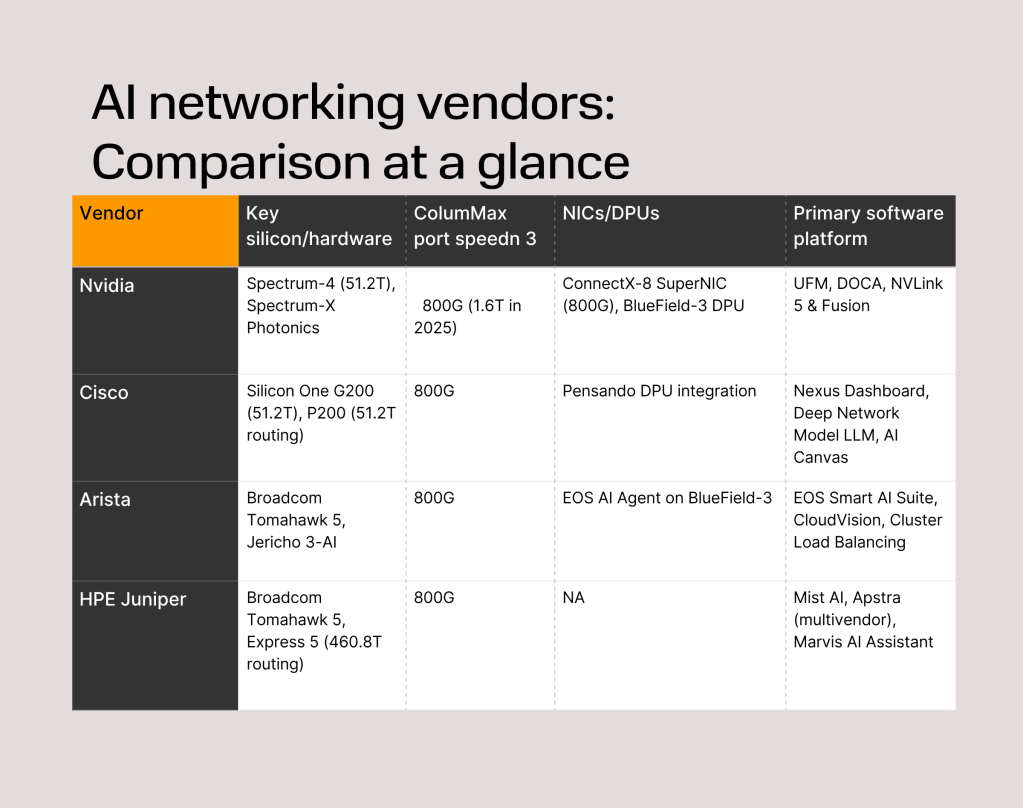
This guide evaluates the five major vendors competing for dominance in AI data center networking as of October 2025: Cisco, HPE Juniper, Arista Networks, Nvidia, and Extreme Networks.
Cisco Systems: The full-stack enterprise play
For decades, Cisco has been the leader in almost every category of networking. With the emergence of AI, Cisco has been innovating to keep its leadership position.
Cisco received over $800 million in AI infrastructure orders from webscale customers in Q4 FY2025, bringing the fiscal year total to over $2 billion and more than doubling the company’s original $1 billion target. The company is leveraging its dominant enterprise position in overall networking market share to become a complete AI infrastructure provider spanning compute, networking, security and management.
Key AI networking hardware
Cisco has a number of key platforms and technologies that are advancing the state of AI networking including the following:
Silicon One P200 & 8223 Router: Industry’s first 51.2 Tbps fixed Ethernet router for distributed AI, announced October 2025 and shipping to hyperscalers. The P200 deep-buffer chip delivers 64×800G ports, processes 20+ billion packets/second and scales to 3 exabits. The 3RU system uses 65% less power than prior generations while supporting 800G coherent optics to 1,000 km.
Silicon One G200: 51.2 Tbps switching chip (5nm process) with 512×112G SerDes. Powers Cisco’s Nexus 9364E-SG2 and is the exclusive partner silicon in Nvidia’s Spectrum-X platform, enabling both native Cisco switches and Spectrum-X enhanced switches.
Nexus 9364E-SG2: 64×800GbE switch in 2RU with 51.2 Tbps throughput, 256MB on-die packet buffer and support for OSFP or QSFP-DD form factors. Based on Silicon One G200 and shipping now.
Smart switches: N9300 series integrates AMD Pensando DPUs directly into switching hardware for stateful security offload. In June 2025 Cisco announced the C9350 and C9610 bringing Silicon One to campus and core for agentic AI workloads.
Software and management platforms
Deep Network Model LLM: Announced at Cisco Live 2025, this networking-specific large language model trained on 40+ years of Cisco expertise and CCIE content provides 20% more precise reasoning for troubleshooting.
AI Canvas: Generative dashboard creation enabling cross-domain troubleshooting across networking, security and observability with natural language queries.
HPE Juniper: AI-native operations through acquisition
HPE completed its $14 billion Juniper acquisition on July 2, 2025, creating a $7B annual revenue networking powerhouse. Former Juniper CEO Rami Rahim leads the combined HPE Networking unit, maintaining both Aruba and Juniper brands. The strategy emphasizes “AI for networks and networking for AI” with networking projected to contribute 50%+ of operating income.
Key AI networking hardware
QFX5240 Series: High-density 800GbE switches delivering 64 ports in 2U (QSFP-DD or OSFP) based on Broadcom Tomahawk 5 ASIC. Validated Ultra Ethernet Transport performance at Interop Tokyo 2025, winning “Best of Show” for line-rate 800Gb forwarding with zero packet drops.
PTX10000 Series: Modular routers with custom Express 5 ASIC delivering up to 460.8 Tbps aggregate in PTX10016 configuration. Features 800G ZR/ZR+ coherent optics enabling Converged Optical Routing Architecture for IPoDWDM applications.
Software and management platforms
Mist AI: Crown jewel of the acquisition with 265+ customers and 50+ managed service providers deployed. August 2025 enhancements include Marvis AI Assistant with 80%+ troubleshooting efficacy, self-driving actions for autonomous remediation, Marvis Minis digital twins for predictive insights and Large Experience Model analyzing billions of data points from collaboration tools and data center telemetry.
Apstra Data Center Director: Intent-based networking with multivendor fabric management supporting Juniper, Cisco, Arista, Dell, Microsoft and Nvidia hardware. Delivers 90% lower OpEx, 85% faster deployment (30 minutes vs 8-12 hours) and 70% MTTR reduction.
GreenLake Intelligence: Unified control plane for hybrid IT with agentic AI agents across networking, compute and storage, including GreenLake Copilot with natural language interface.
Arista Networks: Software innovation and hyperscale validation
Arista holds 18.9% data center Ethernet market share as of Q2 2025, with Q2 2025 revenue of $2.2 billion, up 30.4% YoY and exceeding company projections by $100 million. The company raised 2025 revenue guidance to $8.75B (25% growth) with $1.5B specifically from “AI Center” networking.
7060X6 Series: Latest fixed AI leaf switches (Broadcom Tomahawk 5) delivering 64×800GbE (51.2 Tbps) with 25% lower power per Gbps plus 50% LPO savings. Shipping now with Ultra Ethernet Consortium compatibility.
7800R4 Series: Modular spine scaling to 460 Tbps with 576×800GbE ports using dual Broadcom Jericho 3-AI processors per linecard. Features Virtual Output Queuing architecture eliminating head-of-line blocking.
7700R4 Distributed Etherlink Switch (DES): Radical architecture providing single-hop logical forwarding across physically distributed leaf-spine topology. Scales to 27,000+ ports of 800GbE managing as a single logical cluster. Meta’s deployment for Llama 3 training validates the architecture at massive scale.
Software and management platforms
EOS Smart AI Suite: Launched March 2025 featuring patent-pending Cluster Load Balancing (CLB) achieving 98%+ bandwidth utilization through RDMA queue pair-aware optimization. CloudVision Universal Network Observability (CV UNO) provides 100-microsecond telemetry granularity for job completion tracking. EOS AI Agent runs on Nvidia BlueField-3 SuperNICs for unified NIC-network configuration.
Autonomous Virtual Assist (AVA): AI/ML-powered troubleshooting with natural language queries, zero-touch provisioning and automated deployment.
Nvidia: Vertical integration and silicon photonics leadership
Nvidia networking generated $5.0 billion in Q1 FY2026 (quarter ended April 2025), up 56% YoY. The company’s networking capabilities originated with its $6.9 billion acquisition of Mellanox Technologies in March 2019, bringing InfiniBand and high-speed Ethernet expertise.
Today, Nvidia powers xAI Colossus (100,000+ Hopper GPUs) and holds all MLPerf per-GPU records with 90% scaling efficiency at 2,496 GPUs. March 2025 GTC marked strategic shift as Jensen Huang acknowledged industry moving from infiniBand toward Ethernet while positioning Spectrum-X for “InfiniBand-level performance.”
Key AI networking hardware
Spectrum-X Platform: World’s first AI-specific Ethernet fabric delivering 1.6x greater bandwidth density than standard Ethernet. Spectrum-4 ASIC (51.2 Tbps) supports 128×400GbE with 40% lower power.
Spectrum-XGS: Announced August 2025 for scale-across technology linking distributed data centers. Delivers 1.9x higher NCCL performance through topology-aware congestion control. Available now with CoreWeave deployment.
Spectrum-X Photonics: Silicon photonics with co-packaged optics delivering 1.6Tb/s per port. Scales to 512×800Gb/s (400Tb/s throughput) with 3.5x power efficiency and 10x improved resiliency. Available later in 2025.
Quantum-X800 InfiniBand: 144×800Gb/s with SHARP v4 in-network computing offloading collective operations, reducing network traffic 50% and delivering 10-20% performance improvements.
ConnectX-8 SuperNIC: 800Gb/s throughput with PCIe Gen6 x16 native support. GPUDirect RDMA delivers 10x better performance vs CPU-mediated transfers.
BlueField-3 DPU/SuperNIC: 400Gb/s connectivity with 16 Arm Cortex cores and 32GB DDR5 for software-defined networking, storage and security offload.
Software and management platforms
NVLink 5 and NVLink Switch: Fifth-generation interconnect announced at Computex 2025 delivering 1.8 TB/s per GPU (18 connections at 100 GB/s each), supporting up to 576 GPUs at full speed. NVLink Switch enables 130 TB/s aggregate bandwidth in 72-accelerator NVL72 domains with SHARP v4 in-network computing for 4x bandwidth efficiency.
NVLink Fusion: Announced May 2025, licensing program enabling third-party CPUs and custom accelerators to integrate with Nvidia GPUs via NVLink. October 2025 expansion added Intel (x86 CPUs) and Samsung Foundry partnerships alongside existing Fujitsu, Qualcomm, MediaTek, Marvell and Alchip participants. Enables semi-custom rack designs while maintaining Nvidia’s NVLink performance advantages.
Spectrum-XGS Algorithms: Software protocols announced August 2025 for scale-across networking between distributed data centers. Delivers 1.9x higher NCCL performance through topology-aware congestion control, fine-grain adaptive routing (packet-by-packet) and enhanced long-distance Ethernet optimization.
Extreme Networks: AI management over AI hardware
Extreme deliberately prioritizes AI-powered network management over building specialized hyperscale AI infrastructure, a pragmatic positioning for a vendor targeting enterprise and mid-market. Named a Leader in IDC MarketScape: Worldwide Enterprise Wireless LAN 2025 (October 2025) for AI-powered automation, flexible deployment options and expertise in high-density environments. The company specializes in challenging wireless environments including stadiums, airports and historic venues (Fenway Park, Lambeau Field, Dubai World Trade Center, Liverpool FC’s Anfield Stadium).
Key AI networking hardware
8730 Switch: 32×400GbE QSFP-DD fixed configuration delivering 12.8 Tbps throughput in 2RU for IP fabric spine/leaf designs. Designed for AI and HPC workloads with low latency, robust traffic management and power efficiency. Runs Extreme ONE OS (microservices architecture). Supports integrated application hosting with dedicated CPU for VM-based apps. Available Q3 2025.
7830 Switch: High-density 100G/400G fixed-modular core switch delivering 32×100Gb QSFP28 + 8×400Gb QSFP-DD ports with two VIM expansion slots. VIM modules enable up to 64×100Gb or 24×400Gb total capacity with 12.8 Tbps throughput in 2RU. Powered by Fabric Engine OS. Announced May 2025, available Q3 2025.
Wi-Fi 7 access points: AP4020 (indoor) and AP4060 (outdoor with external antenna support, GA September 2025) completing premium Wi-Fi 7 portfolio.
Extreme Platform ONE: Generally available Q3 2025 with 265+ customers. Integrates conversational, multimodal and agentic AI with three agents (AI Expert, AI Canvas, Service AI Agent) cutting resolution times 98%. Includes embedded Universal ZTNA and two-tier simplified licensing.
ExtremeCloud IQ: Cloud-based network management integrating wireless, wired and SD-WAN with AI/ML capabilities and digital twin support for testing configurations before deployment.
Extreme Fabric: Native SPB-based Layer 2 fabric with sub-second convergence, automated macro and micro-segmentation and free licensing (no controllers required). Multi-area fabric architecture solves traditional SPB scaling limitations.
Analyst Rankings: Market leadership in AI networking
Foundry
Each of the vendors has its own strengths and weaknesses. Analyst reports on the market don’t necessarily show a clear winner but rather a diverse market where enterprises have multiple options.
In the Gartner Data Center Switching Reports (March-April 2025): Magic Quadrant, Cisco, Juniper and Arista Networks occupy the Leaders quadrant, with Arista showing the highest “ability to execute.” HPE ranks as a Challenger alongside Nvidia and Extreme Networks in the Niche Players quadrant. Juniper scored highest in Enterprise Data Center Network Build-out, second highest in AI Ethernet Fabric Build-out and second highest in SONiC-Based Data Center Network Build-out use cases.
According to IDC Datacenter Ethernet Market Share (Q2 2025), Nvidia surpassed both Arista and Cisco in the datacenter segment with 25.9% share ($2.3B), up 647% YoY. Arista holds 18.9% share ($1.83B), while Cisco maintains 27.3% of the total Ethernet market. This marks a dramatic shift from Q1 2025 when Arista led at 21.3% ($1.48B) and Nvidia trailed at 21.1% ($1.46B), demonstrating Nvidia’s Spectrum-X momentum in AI workloads.
While traditional leaders (Cisco, Arista, Juniper) maintain strong positions in enterprise data centers, the AI-specific networking market shows Nvidia rapidly gaining ground through vertical integration and Spectrum-X adoption. The 2025 competitive landscape is fragmenting as organizations hedge bets across multiple vendors for both compute and networking.