
Nvidia is open-sourcing its cuFile APIs and putting its weight behind the Storage-Next initiative.
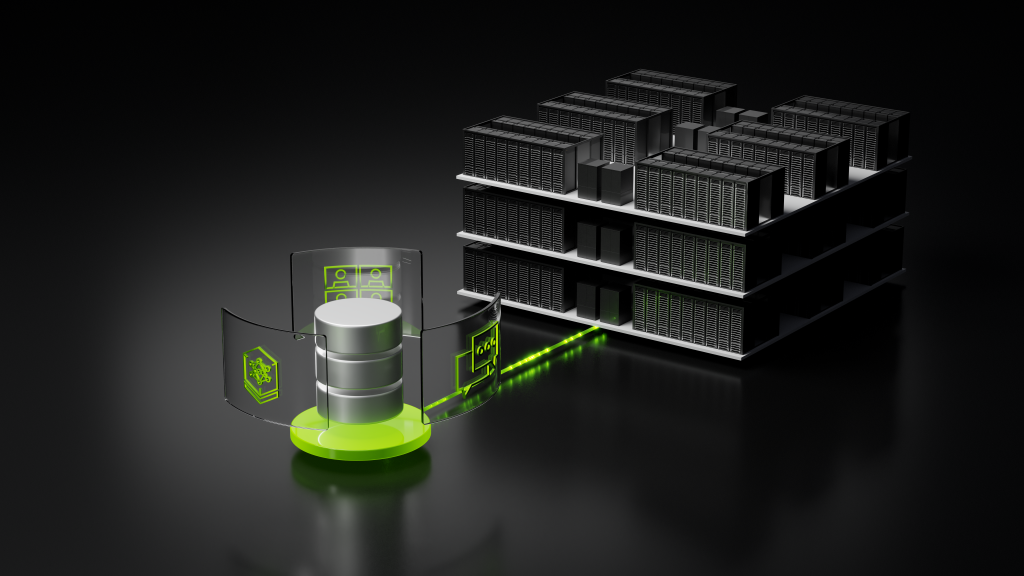
Nvidia is looking to speed access to AI storage and memory systems by open-sourcing its cuFile APIs and software stack. It’s also promoting a new 40-vendor initiative that aims to standardize GPU-driven storage advancements.
At this week’s Future of Memory and Storage (FMS) conference, Nvidia said it would open-source its cuFile APIs and the vertical storage software stack underneath them, which allow GPUs, not just CPUs, to read from and write to storage directly. cuFile is an Nvidia software library that is part of its GPUDirect Storage (GDS) platform, and the APIs will be developed under the Accelerated IO Special Interest Group (xio-sig), an industry consortium focused on creating open standards for high-performance, low-latency I/O.
The move is intended to foster broader adoption and interoperability across the AI storage industry, making cuFile a more open foundation for AI-native storage rather than a proprietary Nvidia-only interface, according to Jason Hardy, vice president of storage technology at Nvidia.
As GPUs become faster, storage is increasingly the bottleneck, and many GPUs can process data faster than many storage systems can deliver it. The idea behind cuFile is to increase storage throughput, reduce latency, improve GPU utilization, and speed AI training and inference workloads, Hardy wrote in a blog post about the news.
“Using hundreds of thousands of GPU threads, fast high-bandwidth memory and other methodologies, cuFile enables securely accessing data from storage in just microseconds,” Hardy wrote. “In addition, fast, secure access to data and storage is a foundational element to powering preventive and detective cybersecurity measures. Making cuFile openly available will help make security context, data and storage accessible at the speed AI-powered defenses need. Such open technologies support initiatives such as the new Open Secure AI Alliance.”
The xio-sig site is the new home for APIs that are open to contributions — with Google, Intel, Nvidia, and Meta as some of the first contributors — and can be optimized for use across various software and hardware platforms, driving innovation and efficiency for developers and enterprises, according to Hardy.
Nvidia also said it will be a leader of a new memory and storage industry initiative called Storage-Next. Storage-Next will bring together over 40 storage makers, controller vendors, thermal design, cooling and orchestration operators, and standards bodies to align on how GPU-driven storage should behave — then turn these advancements into interoperable, open industry standards, Hardy stated. The group will include DDN, Kioxa and Micron, each contributing to AI storage technologies.
“The initiative is grounded in accelerated data access for large AI datasets. To support this effort, Nvidia offers scaled, accelerated data access or SCADA — a framework that lets massively parallel GPUs pull only the data necessary for the application directly from storage into their own high-speed memory,” Hardy stated.
Storage vendor DDN is integrating SCADA with Infinia, its software-defined, AI-native data intelligence platform, for example. “Our collaboration with Nvidia is helping create a more direct, efficient connection between GPUs and data — keeping accelerated computing resources productive, speeding time to insight and enabling customers to achieve stronger business and financial returns from their AI investments,” stated Sven Oehme, chief technology officer at DDN, in the Hardy blog.
Hardy added that Storage-Next and SCADA extend Nvidia’s longstanding work on AI storage infrastructure, including its Nvidia Vera BlueField-4 STX — a modular, rack-scale foundation powered by the Nvidia Vera Rubin platform, Vera BlueField-4 storage processors, and Spectrum-X Ethernet networking.
Nvidia’s STX unifies its Vera, Rubin, and BlueField-4 packages into a system fort high-performance storage, enterprise AI data, and memory. Nvidia STX is a key driver for the vendor as it unifies its Vera, Rubin, BlueField-4 and Spectrum-X Ethernet networking technologies to offer a blueprint for customers to upgrade traditional storage systems, Nvidia states.





