
Zooming technique enlarges text type for smartwatches, ultra-small computers
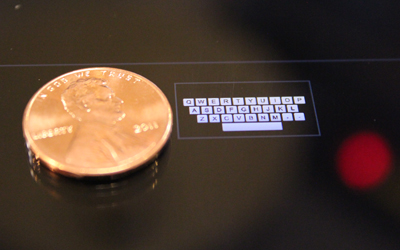
If smartwatches and other ultra-small devices are to become the text generators of the future, their diminutive keyboards are going to have to be way more useful for, um, big fingered typists.
Carnegie Mellon researchers may have the answer to that problem. Called ZoomBoard, the text entry technique is based on the iconic QWERTY keyboard layout.
[IN THE NEWS: No humor zone: 33 things you should never say to a TSA agent]
“Though the full keyboard is impossibly small on a watch-size display, simply tapping the screen once or twice will enlarge an individual key until it can be comfortably and accurately pressed. Capital letters can be typed by momentarily holding a key. A swipe to the left deletes a character. A swipe to the right types a space. An upward swipe calls up a secondary keyboard of numbers and other symbols.
“You aren’t going to write a novel, but it gets the job done,” said Stephen Oney, a Ph.D. student in the Human-Computer Interaction Institute in a statement. “This opens up new possibilities for devices such as smartwatches, which generally lack any means of entering text, as many aren’t powerful enough for voice recognition.”
On their website, the researchers said: “As the ultimate test, we ran a text entry experiment on a keyboard measuring just 16 x 6mm – smaller than a US penny. Users achieved roughly 10 words per minute, allowing users to enter phone numbers and searches such as “closest pizza” and “directions home” both quickly and quietly.”
The researchers will present their technology paper, “ZoomBoard: A Diminutive QWERTY Soft KeyboardUsing Iterative Zooming for Ultra-Small Devices,” May 1 at CHI 2013, the Conference on Human Factors in Computing Systems, in Paris.
Check out these other hot stories:
- DARPA wants huge Holy Grail of mobile ad hoc networks
- More weirdness at TSA passenger screening: Human skull fragments
- Getting junk out of Earth’s orbit needs more urgency
- IBM robotic coworker will help engineers fix broken systems
- Solar electric spacecraft propulsion could get NASA to an asteroid, beyond
- Can NASA, Air Force, private industry really mitigate asteroid threat?





