
Star Trek used a Transporter to bend time and space, CalTech and Cornell spy real world warping
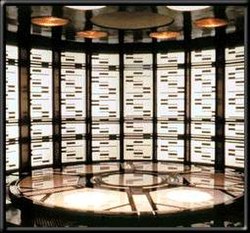
The closest I have come to visualizing warped space or time would probably be from Star Trek when crew member would beam up and down from the Starship Enterprise’s Transporter room to other planets and dimensions. It was simple and required some imagination but not too much.
Physicists looking at real-life bending of time and space in the cosmos of course look at such things differently and today said they have come up with a way to view that warping like never before.
By combining theory with computer simulations, scientists from the California Institute of Technology (Caltech), Cornell University and the National Institute for Theoretical Physics in South Africa have developed conceptual tools they’ve dubbed tendex lines and vortex lines. Tendex and vortex lines describe the gravitational forces caused by warped space-time and are analogous to the electric and magnetic field lines that describe electric and magnetic forces, the researchers say.
Using these tools, for example the researchers said they have discovered that in space, collisions in black-holes can produce vortex lines that form a doughnut-shaped pattern, flying away from the merged black hole like smoke rings. The researchers also found that these bundles of vortex lines-called vortexes-can spiral out of the black hole like water from a rotating sprinkler.
From the researchers: “Tendex lines describe the stretching force that warped space-time exerts on everything it encounters. “Tendex lines sticking out of the moon raise the tides on the earth’s oceans,” says David Nichols, the Caltech graduate student who coined the term “tendex.” The stretching force of these lines would rip apart an astronaut who falls into a black hole. Vortex lines, on the other hand, describe the twisting of space. If an astronaut’s body is aligned with a vortex line, she gets wrung like a wet towel “
“Though we’ve developed these tools for black-hole collisions, they can be applied wherever space-time is warped,” says Dr. Geoffrey Lovelace, a member of the team from Cornell in a statement. “For instance, I expect that people will apply vortex and tendex lines to cosmology, to black holes ripping stars apart, and to the singularities that live inside black holes. They’ll become standard tools throughout general relativity.”
If you want to read the actual research go here: Physical Review Letters: “Frame-dragging vortexes and tidal tendexes attached to colliding black holes: Visualizing the curvature of spacetime”
Check out these other hot stories:
- Vengeful programmer gets two years in prison for botnet attack
- US goes after some game-changing energy projects
- Free DARPA software lets gamers hunt submarines
- Computer factories eat way more energy than running the devices they build
- ‘We regret to inform you’: The Epsilon breach letters you don’t want to see
- UPDATE: Underwater robots find airline wreckage, bodies
- IT “geek squad” wins $319 million Mega Millions lottery
- FBI wants you to solve encrypted notes from murder mystery
- Should smartphones be allowed in the courthouse?





