A guide to the open-source foundations, projects, and use cases that provide network professionals with a map for vendor independence and advanced automation.

Two decades ago, Linux emerged as a mainstream operating system and was perhaps the most well-known open source technology.
What has emerged around Linux as part of the broader networking ecosystem are a series of open source technologies and projects that have become foundation to modern connectivity. Open source networking has gone mainstream. In fact, 92% of organizations now view it as critical to their future, according to Linux Foundation “2025 Open Source Networking Study: The Role and Value of Open Source in the Networking Industry’s Software Stack.” Understanding this landscape is no longer optional for network professionals.
This Linux Foundation guide maps the active open source projects that power modern infrastructure — from hyperscale cloud data centers to 5G networks. These projects collectively represent millions of dollars in shared innovation and are deployed in production at the world’s largest networks.
Why open source networking matters
Three forces are encouraging organizations to use open source networking software:
Breaking vendor lock-in. Projects like SONiC let organizations run the same software stack across hardware from hundreds of vendors. Organizations report 40-50% reductions in total cost of ownership by eliminating licensing fees and using commodity hardware.
Faster innovation. There are over 1,300 contributors across major projects, which means that those projects deliver early access to emerging technologies like AI integration and 5G without waiting for vendor roadmaps. 74% of organizations see open source as foundational to AI success in networks.
Real interoperability. Standardized APIs and interfaces mean you can mix and match components from different projects.
Open source foundations drive development and governance
While there can be individual efforts led by companies, the most influential and impactful open -source networking efforts tend to fit into one of the major open source foundations.
The Linux Foundation itself is a ‘foundation of foundations’ and is home to multiple groups including:
Linux Foundation Networking (LFN) hosts the largest portfolio of projects. Formed in 2018 by merging the OPNFV, ONAP, OpenDaylight and FD.io projects, it now includes over a dozen projects spanning software-defined networking (SDN) controllers, orchestration, data plane acceleration, and emerging technologies. Recent 2025 additions include Duranta (Open RAN), Essedum (AI networking) and Project Salus (responsible AI). LFN provides the governance structure for projects like OpenDaylight, ONOS, ONAP, DPDK, VPP and Nephio.
Cloud Native Computing Foundation (CNCF) focuses on containerized applications. With over 700 member organizations, CNCF graduated the projects that now run most Kubernetes networking: Cilium, Istio, Linkerd, Envoy, and CoreDNS. The foundation’s incubating and sandbox projects include CNI (container networking interface) implementations like Contour, Kube-OVN, and Antrea.
OpenInfra Foundation (formerly OpenStack Foundation) maintains OpenStack Neutron, the network-as-a-service component for cloud platforms. Neutron continues serving enterprise private cloud deployments worldwide.
SONiC Foundation governs the data center network operating system running Microsoft Azure’s entire global network. Launched in 2020 when SONiC moved to Linux Foundation governance, the foundation coordinates development across over 850 community members and ensures hardware compatibility with hundreds of vendors. SONiC represents the most widely deployed open source network OS in hyperscale environments.
There are a few efforts outside of the Linux Foundations, including the following:
Open Compute Project (OCP) drives open hardware specifications for data center infrastructure. Founded by Facebook in 2011, OCP created the hardware ecosystem that enables software-defined networking at scale. The project’s switch specifications provide the foundation for SONiC and other network operating systems, with contributions from Microsoft, Google, Meta, and hundreds of hardware vendors.
Apache Software Foundation (ASF) hosts a number of critical projects, including the Apache HTTP Server which is the original widely used open source web server for providing HTTP services.
Key projects by use case
Open source networking projects spans the entire landscape of networking deployment with multiple core use cases:
Data center infrastructure
- SONiC dominates modern data center deployments as the leading open source network operating system, running on white-box switches from hundreds of vendors through the Switch Abstraction Interface (SAI). The containerized microservices architecture enables hardware independence while maintaining production-grade reliability.
- DPDK (data plane development kit) bypasses the Linux kernel’s network stack by moving packet processing into userspace, eliminating context switches and enabling direct memory access to network interfaces. This architecture delivers order-of-magnitude performance improvements compared to traditional kernel-based networking.
- VPP (vector packet processing) from FD.io builds on DPDK with a graph-based processing model that handles multiple packets simultaneously through the same code path rather than processing packets individually.
- Open vSwitch remains the production standard for virtual switching.
Kubernetes networking
- Cilium leads the Container Network Interface implementations with eBPF-based architecture that replaces iptables for better performance.
- Service mesh options include Istio and Linkerd. Istio offers comprehensive features built on Envoy proxy with zero-trust networking, mTLS encryption, advanced traffic management and extensive observability. Linkerd emphasizes simplicity with a lightweight Rust-based proxy.
- Envoy serves as the foundational L7 proxy underlying most service meshes and API gateways.
Automating network operations
- NAPALM provides the industry-standard abstraction layer for multivendor network automation.
- NetBox serves as the network source of truth combining IPAM and DCIM functionality.
- Batfish analyzes configurations pre-deployment by building behavioral models. It catches errors before they hit production without needing device access.
Operating service provider networks
- ONAP orchestrates complete NFV and cloud-native infrastructure for service providers.
- FRRouting provides production routing capabilities with full protocol support.
- Akraino Edge Stack addresses edge computing requirements
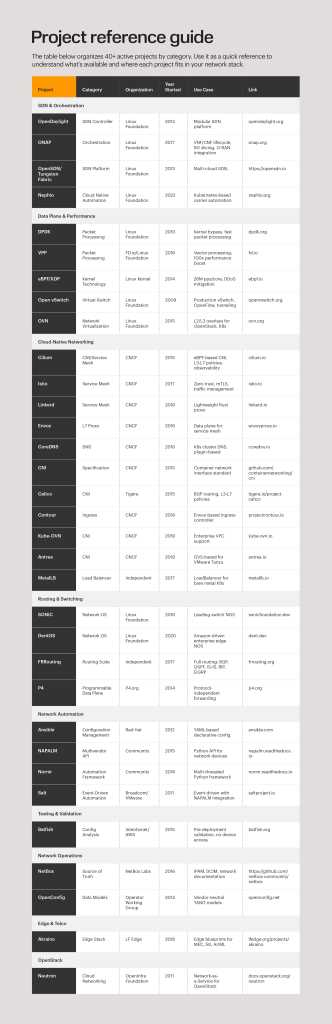
We break down more than 40 open source projects in these categories: SDN and orchestration, data plane and performance, cloud-native networking, routing and switching, network automation, testing and validation, network operations, edge and telco, and OpenStack.
Foundry





